
Discussion
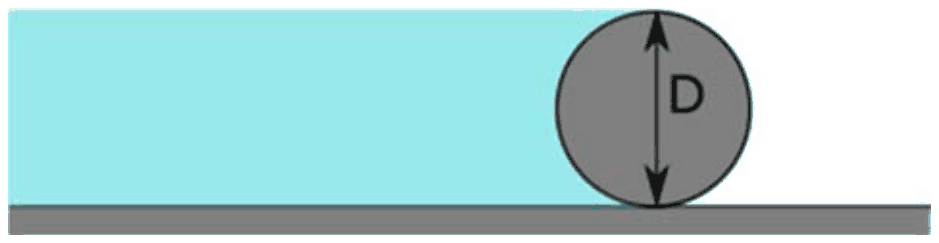
A heavy horizontal cylinder of diameter \(D\) supports a mass of liquid having density \(\rho\) as shown in the figure. Find out the vertical component of force exerted by the liquid per unit length of the cylinder if \(g\) is the acceleration due to gravity.
Answer: B
The vertical force is \(\frac{\pi D^{2}}{8}\rho g\) per unit length, acting upward.
The liquid touches the left half of the cylinder, from the floor contact at the bottom up to the top, where the free surface lies. The vertical force on a curved surface equals the weight of liquid, real or imaginary, between the surface and the free-surface level.
- On the upper-left quarter the liquid lies above the surface and pushes down.
- On the lower-left quarter the liquid pushes up, with the imaginary liquid column reaching up to the free surface.
The two columns overlap except for the half-circle itself, so the net force is the weight of liquid that would fill the left half of the cylinder:
\[ \begin{aligned} F_{V} &= \rho g \cdot \frac{1}{2}\cdot\frac{\pi D^{2}}{4} \\ &= \frac{\pi D^{2}}{8}\rho g \end{aligned} \]
\(\pi D^{2}/4\) is the buoyancy of the whole cylinder, which would need liquid all round it; the other two options do not correspond to any part of the wetted surface.
Post your comment
Please log in or register to post a comment.
Examination Categories
- SSC Exams
- Banking Exams
- Teaching Exams
- Civil Services Exams
- Railways Exams
- Engineering Recruitment Exams
- Defence Exams
- State Government Exams
- Police Exams
- Insurance Exams
- Nursing Exams
- Other Government Exams
- NRA CET
- PG Entrance Exams
- Campus Placement
- MBA Entrance Exams
- CUET and UG Entrance
- Judiciary Exams
- Regulatory Body Exams
- Software Development