
Discussion
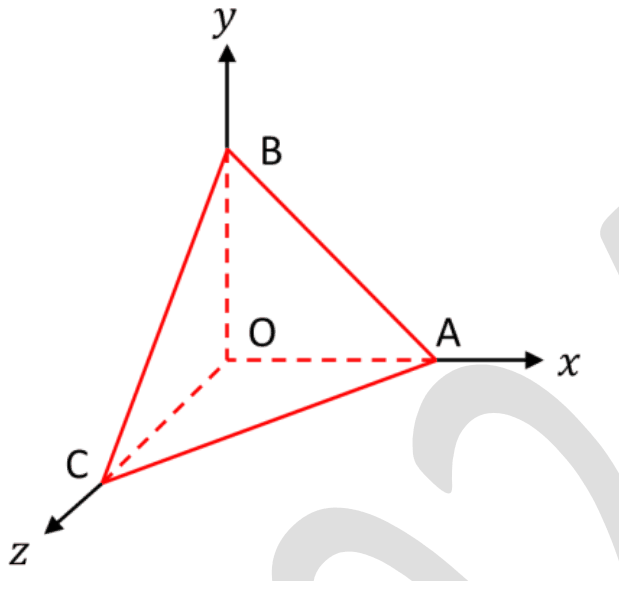
A rigid massless tetrahedron is placed such that vertex O is at the origin and the other three vertices A, B, and C lie on the coordinate axes as shown in the figure. The body is acted on by three point loads, of which one is acting at A along \(x\)-axis and another at point B along \(y\)-axis. For the body to be in equilibrium, the third point load acting at point O must be
Answer: B
The third load must act in the x - y plane but not along x or y axis.
The load at A acts along the x-axis and A lies on that axis, so its line of action passes through O. Likewise the load at B acts along the y-axis, through O. The third load acts at O itself. All three lines pass through O, so the moments about O are zero automatically, and equilibrium needs only the forces to sum to zero:
\[ \mathbf{F}_{O} = -(F_{A}\,\hat{i} + F_{B}\,\hat{j}) \]
With both given loads non-zero, this force has x and y components and no z component: it lies in the x-y plane but along neither axis. A force along the z-axis, or in the y-z or z-x planes, would leave an unbalanced component in x or y.
Post your comment
Please log in or register to post a comment.
Examination Categories
- SSC Exams
- Banking Exams
- Teaching Exams
- Civil Services Exams
- Railways Exams
- Engineering Recruitment Exams
- Defence Exams
- State Government Exams
- Police Exams
- Insurance Exams
- Nursing Exams
- Other Government Exams
- NRA CET
- PG Entrance Exams
- Campus Placement
- MBA Entrance Exams
- CUET and UG Entrance
- Judiciary Exams
- Regulatory Body Exams
- Software Development