
Discussion
Two axial members, namely OP and OQ, are pin joined at O as shown in the figure. A force F acts at point P along the positive x direction and a force \(\sqrt{3}F\) acts at point Q along the positive y direction.
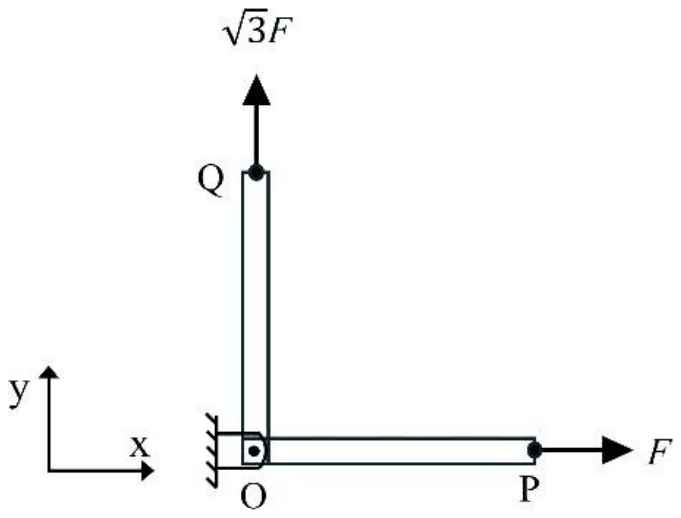
The resultant of the applied forces makes an angle \(\theta\) (anticlockwise from the positive x-axis).
The value of \(\theta\) is ___.
Answer: C
The resultant makes an angle of 60° with the positive x-axis.
The two forces are perpendicular, F along x and \(\sqrt{3}F\) along y. Their resultant has components (F, \(\sqrt{3}F\)), so:
\[ \begin{aligned} \tan\theta &= \frac{\sqrt{3}F}{F} = \sqrt{3} \\ \theta &= 60^{\circ},\quad |R| = 2F \end{aligned} \]
30° is the angle the resultant makes with the y-axis, a slip from swapping the components. 45° would need equal components, and 75° has no basis.
Post your comment
Please log in or register to post a comment.
Examination Categories
- SSC Exams
- Banking Exams
- Teaching Exams
- Civil Services Exams
- Railways Exams
- Engineering Recruitment Exams
- Defence Exams
- State Government Exams
- Police Exams
- Insurance Exams
- Nursing Exams
- Other Government Exams
- NRA CET
- PG Entrance Exams
- Campus Placement
- MBA Entrance Exams
- CUET and UG Entrance
- Judiciary Exams
- Regulatory Body Exams
- Software Development