
Discussion
A piecewise regular function \(f(x)\) is shown in the figure. It is expanded in Fourier series given by
\[ \begin{aligned} f(x) = \frac{a_{0}}{2} &+ \sum_{n=1}^{\infty} a_{n}\cos(nx) \\ &+ \sum_{n=1}^{\infty} b_{n}\sin(nx), \end{aligned} \]
where \(a_{0}, a_{n}, b_{n}\)’s are the Fourier coefficients.
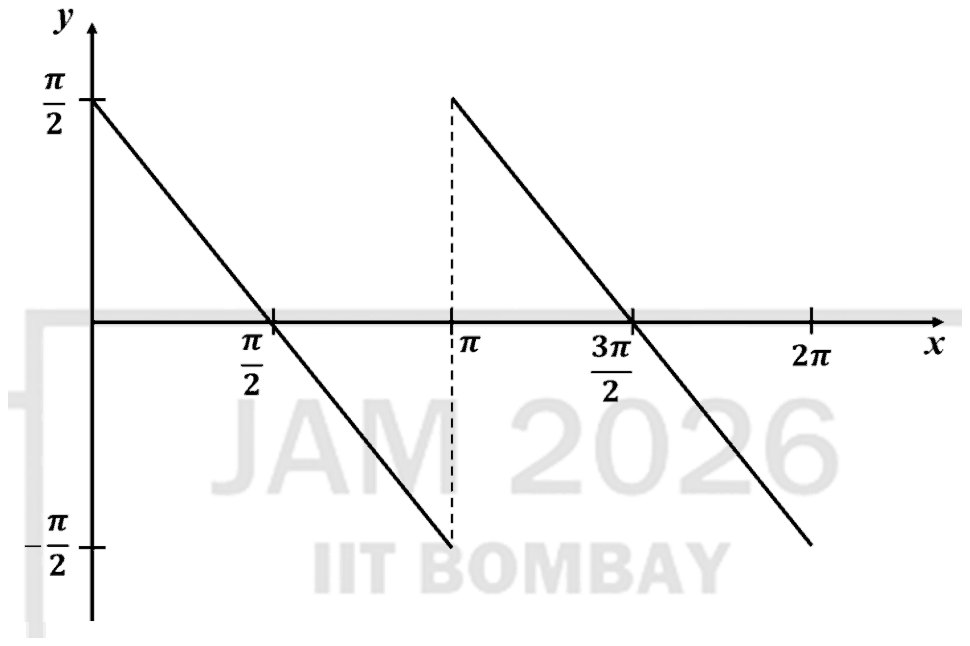
Which of the following options is correct?
Answer: B
The correct option is that all \(a_n\) are zero.
On \(0 < x < \pi\) the graph is \(f(x) = \frac{\pi}{2} - x\), repeated with period \(\pi\). Shifting one period back, on \(-\pi < x < 0\) it is \(f(x) = -\frac{\pi}{2} - x\). So for \(0 < x < \pi\):
\[ f(-x) = -\tfrac{\pi}{2} + x = -f(x) \]
The function is odd. The cosine coefficients \(a_n = \frac{1}{\pi}\int_{-\pi}^{\pi} f(x)\cos nx\,dx\) integrate an odd function over a symmetric interval, so every one of them, \(a_0\) included, is zero; only sine terms survive.
Since \(a_0\) is twice the average value and the sawtooth averages to zero, \(a_0 = 3\pi\) and \(a_0 = 3\pi/2\) are wrong. The \(b_n\) cannot all vanish, or \(f\) would be identically zero.
Post your comment
Please log in or register to post a comment.
Examination Categories
- SSC Exams
- Banking Exams
- Teaching Exams
- Civil Services Exams
- Railways Exams
- Engineering Recruitment Exams
- Defence Exams
- State Government Exams
- Police Exams
- Insurance Exams
- Nursing Exams
- Other Government Exams
- NRA CET
- PG Entrance Exams
- Campus Placement
- MBA Entrance Exams
- CUET and UG Entrance
- Judiciary Exams
- Regulatory Body Exams
- Software Development