
Discussion
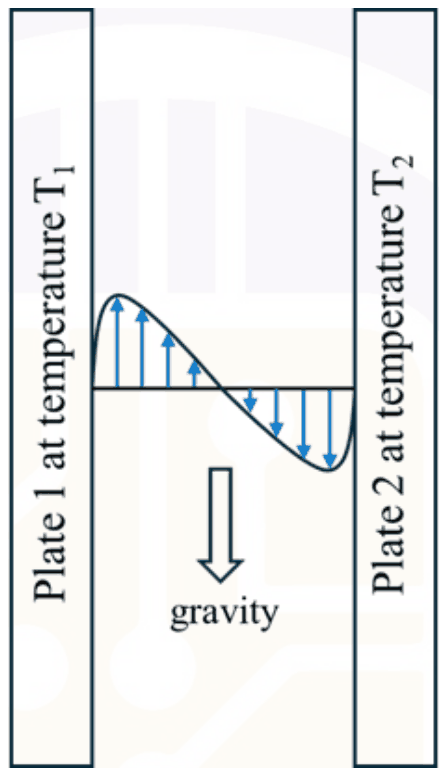
A quiescent fluid at temperature \(T_{3}\) is confined between two vertical parallel plates. While plate 1 is kept at temperature \(T_{1}\) and plate 2 is maintained at temperature \(T_{2}\), a velocity profile between the plates, as shown in the figure below, is generated due to heat transfer. Which one of the following options shows the correct relations among \(T_{1}, T_{2}\), and \(T_{3}\)?
Answer: A
The relations are \(T_{1} \gt T_{3}\) and \(T_{3} \gt T_{2}\).
The flow is natural convection. Fluid moves upward next to plate 1, so it is lighter there, which means it has been heated: plate 1 is hotter than the fluid, \(T_{1} \gt T_{3}\). Fluid moves downward next to plate 2, so it is heavier there and has been cooled: plate 2 is colder than the fluid, \(T_{3} \gt T_{2}\).
Each of the other options reverses at least one of these, which would reverse the direction of flow at that plate.
Post your comment
Please log in or register to post a comment.
Examination Categories
- SSC Exams
- Banking Exams
- Teaching Exams
- Civil Services Exams
- Railways Exams
- Engineering Recruitment Exams
- Defence Exams
- State Government Exams
- Police Exams
- Insurance Exams
- Nursing Exams
- Other Government Exams
- NRA CET
- PG Entrance Exams
- Campus Placement
- MBA Entrance Exams
- CUET and UG Entrance
- Judiciary Exams
- Regulatory Body Exams
- Software Development