
Discussion
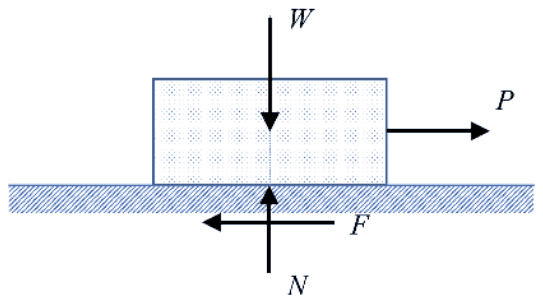
A block of weight \(W\), placed on a surface, is subjected to a horizontal force \(P\) as shown in the figure. The line of action of force \(P\) passes through the center-of-gravity of the block. The magnitude of \(P\) is such that the block remains at rest. If \(N\) is the resultant normal reaction exerted by the surface, and \(F\) is the frictional force acting on the bottom surface of the block, then which of the following represents the correct free body diagram of the block?
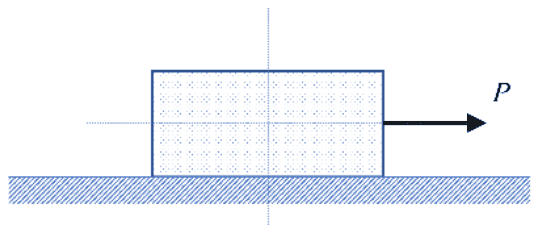
- A.
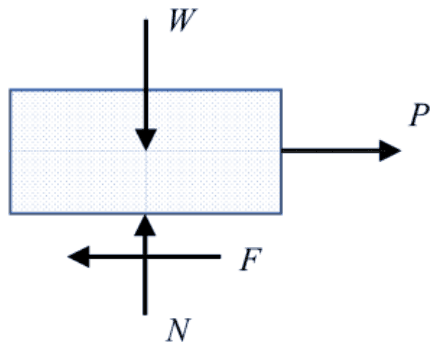
- B.
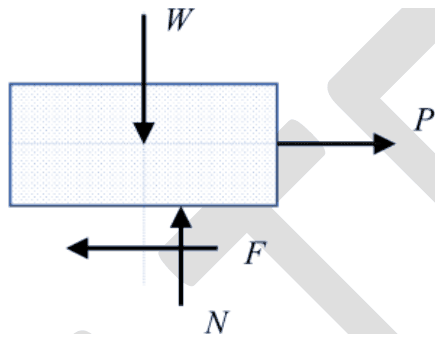
- C.
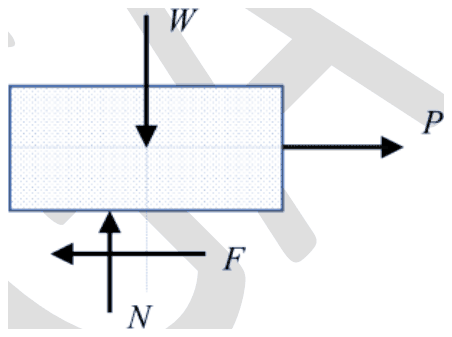
- D.
Answer: B
The correct free body diagram is (B).
A free body diagram shows the block alone, with every external force: W at the centre of gravity, P through the centre of gravity, friction F at the base opposing P, and the normal reaction N. Horizontal balance gives F = P and vertical balance N = W.
F acts at the base, below the line of P, so P and F form a couple that tends to tip the block forward. To balance it, N must act at a point shifted forward of W's line, in the direction of P, by \(x = Ph/W\) for P at height h. Diagram (B) shows this shift.
In (A) N and W are collinear, leaving the P-F couple unbalanced. In (C) N is shifted the wrong way. (D) draws the supporting surface, which a free body diagram must leave out, and has N in line with W.
Post your comment
Please log in or register to post a comment.
Examination Categories
- SSC Exams
- Banking Exams
- Teaching Exams
- Civil Services Exams
- Railways Exams
- Engineering Recruitment Exams
- Defence Exams
- State Government Exams
- Police Exams
- Insurance Exams
- Nursing Exams
- Other Government Exams
- NRA CET
- PG Entrance Exams
- Campus Placement
- MBA Entrance Exams
- CUET and UG Entrance
- Judiciary Exams
- Regulatory Body Exams
- Software Development