
Discussion
Consider two blocks, P of mass 100 kg and Q of mass 150 kg, resting as shown in the figure. The angle \(\theta = 30^{\circ}\). The coefficient of friction between the two blocks is 0.2. Assume no friction exists at all other interfaces. The minimum force required to move the block P upward is W.
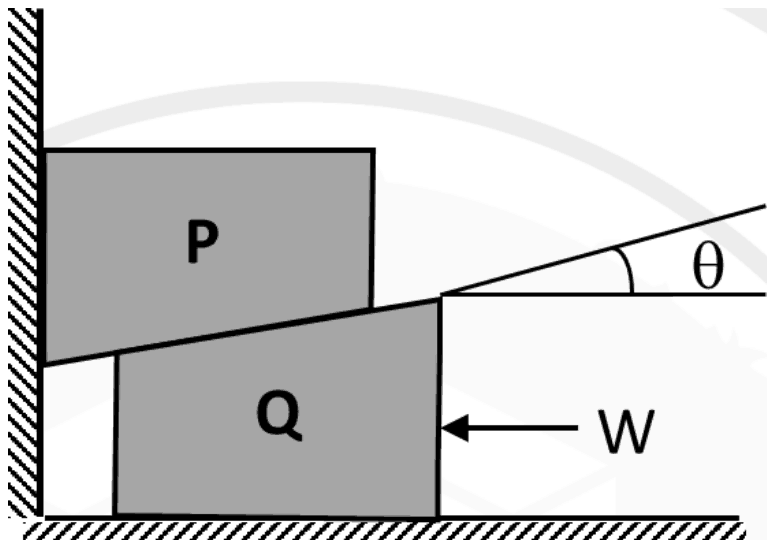
Which one of the following options is closest to the CORRECT magnitude of W (in N)?
Answer: A
The minimum force is about 862.2 N.
As W pushes Q toward the wall, the inclined face of Q lifts P up the frictionless wall. Relative to Q, P slides up the incline, so friction on P (0.2N) acts down the incline. Take N as the normal force between the blocks and \(\theta = 30^{\circ}\).
Vertical equilibrium of P, weight 100 × 9.81 = 981 N:
\[ \begin{aligned} N\cos\theta - 0.2N\sin\theta &= 981 \\ N(0.866 - 0.1) &= 981 \\ N &= 1280.7\ \text{N} \end{aligned} \]
Horizontally, Q has only W on one side and the horizontal parts of N and the friction from P on the other (the floor is frictionless):
\[ \begin{aligned} W &= N\sin\theta + 0.2N\cos\theta \\ &= 1280.7(0.5 + 0.1732) = 862.2\ \text{N} \end{aligned} \]
Q's own weight acts vertically and is carried by the floor, so it does not enter W. Leaving out friction gives \(981\tan 30^{\circ} = 566\) N, which is not offered; the larger options do not satisfy the two equilibrium equations.
Post your comment
Please log in or register to post a comment.
Examination Categories
- SSC Exams
- Banking Exams
- Teaching Exams
- Civil Services Exams
- Railways Exams
- Engineering Recruitment Exams
- Defence Exams
- State Government Exams
- Police Exams
- Insurance Exams
- Nursing Exams
- Other Government Exams
- NRA CET
- PG Entrance Exams
- Campus Placement
- MBA Entrance Exams
- CUET and UG Entrance
- Judiciary Exams
- Regulatory Body Exams
- Software Development