
Discussion
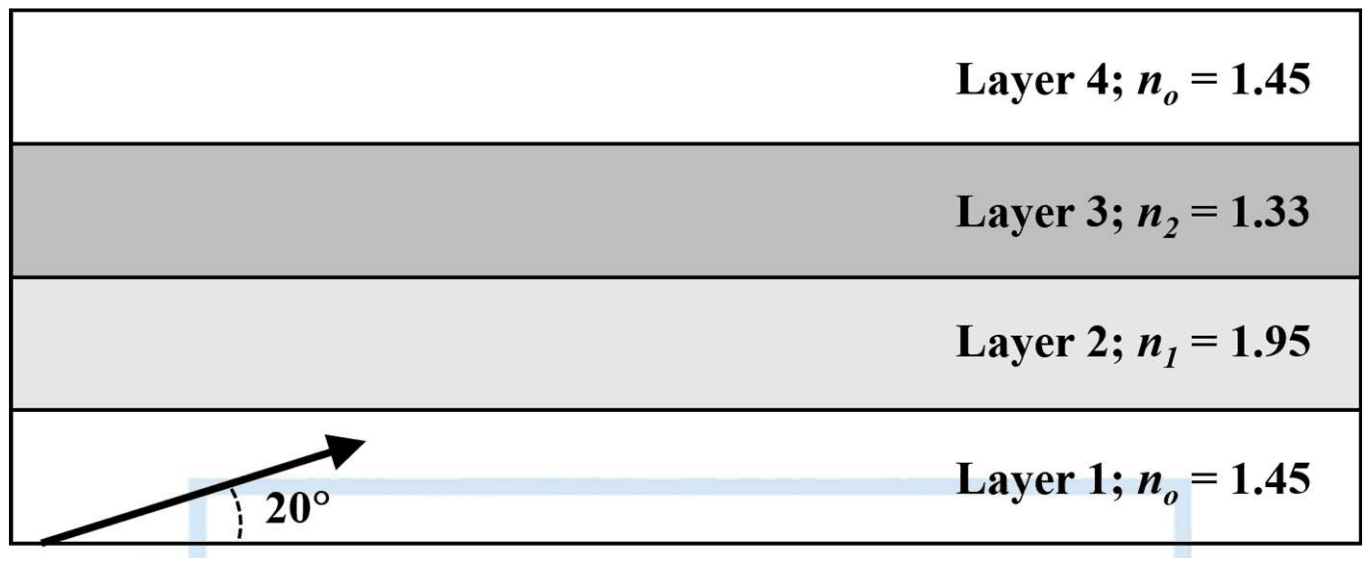
Consider a multilayered structure composed of thin films of refractive indices no, n1, and n2 as shown in the figure. A ray traveling in the first layer hits the interface at an angle of 20° with the horizontal. Which of the following options is correct?
Answer: C
The correct option is that the ray would not enter the 3rd layer.
A ray at 20° to the horizontal makes 70° with the normal. For parallel layers, Snell's law keeps \(n \sin\theta\) the same in every layer:
\[ \begin{aligned} n\sin\theta &= 1.45 \sin 70^\circ = 1.363 \\ \text{layer 2:}\ \sin\theta_2 &= 1.363/1.95 = 0.699 \\ \text{layer 3:}\ \sin\theta_3 &= 1.363/1.33 = 1.025 \end{aligned} \]
The ray enters layer 2 at about 44° from the normal, but a sine greater than 1 is impossible, so at the boundary with layer 3 it is totally internally reflected.
The trap is the 20° option: layer 4 has the same index as layer 1, so if the ray did get through it would leave at 20° again, but it never reaches layer 4. 44° is the angle from the normal inside layer 2, not an angle in layer 4.
Post your comment
Please log in or register to post a comment.
Examination Categories
- SSC Exams
- Banking Exams
- Teaching Exams
- Civil Services Exams
- Railways Exams
- Engineering Recruitment Exams
- Defence Exams
- State Government Exams
- Police Exams
- Insurance Exams
- Nursing Exams
- Other Government Exams
- NRA CET
- PG Entrance Exams
- Campus Placement
- MBA Entrance Exams
- CUET and UG Entrance
- Judiciary Exams
- Regulatory Body Exams
- Software Development