
Discussion
In the given figure, PQRS is a parallelogram with PS = 7 cm, PT = 4 cm and PV = 5 cm. What is the length of RS in cm? (The diagram is representative.)
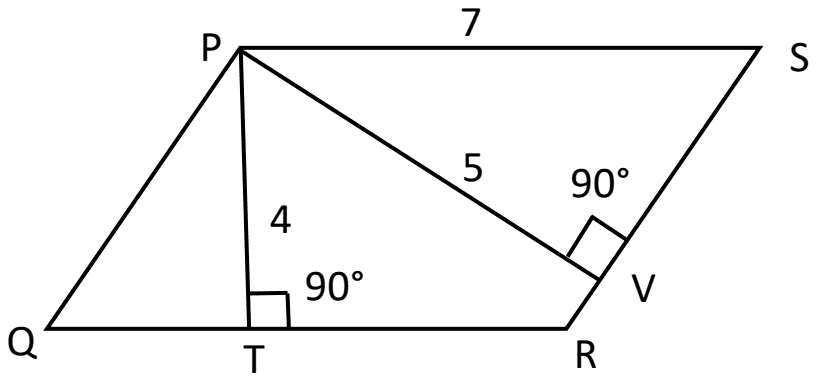
Answer: B
RS is 28/5 cm.
The area of a parallelogram is any side times the perpendicular distance to it from the opposite side. PT is the height on base QR, and PV is the height on base RS.
\[ \begin{aligned} QR \times PT &= RS \times PV \\ 7 \times 4 &= RS \times 5 \\ RS &= \frac{28}{5} = 5.6\ \text{cm} \end{aligned} \]
QR equals PS = 7 cm because opposite sides of a parallelogram are equal. 20/7 is PT times PV divided by PS, which mixes the two heights, and 35/4 is PS times PV over PT, which pairs each height with the wrong base.
No comment is present. Be the first to comment.
Loading…
Post your comment
Please log in or register to post a comment.
Examination Categories
- SSC Exams
- Banking Exams
- Teaching Exams
- Civil Services Exams
- Railways Exams
- Engineering Recruitment Exams
- Defence Exams
- State Government Exams
- Police Exams
- Insurance Exams
- Nursing Exams
- Other Government Exams
- NRA CET
- PG Entrance Exams
- Campus Placement
- MBA Entrance Exams
- CUET and UG Entrance
- Judiciary Exams
- Regulatory Body Exams
- Software Development