
Discussion
In the given figure, PQRS is a square of side 2 cm and PLMN is a rectangle. The corner L of the rectangle is on the side QR. Side MN of the rectangle passes through the corner S of the square.
What is the area (in cm2) of the rectangle PLMN?
Note: The figure shown is representative.
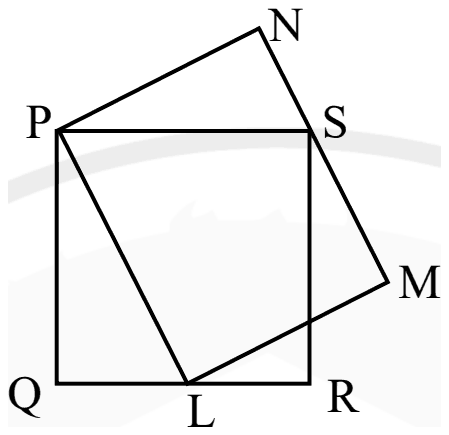
Answer: D
The area of the rectangle is 4 cm2.
Look at the triangle PLS. Measured against the square, it has base PS (a side, 2 cm) and its third vertex L on the opposite side QR, so its height is also 2 cm:
\[ \tfrac{1}{2} \times 2 \times 2 = 2\ \text{cm}^{2} \]
Measured against the rectangle, the same triangle has base PL (a side of the rectangle) and its third vertex S on the opposite side MN. A triangle on one side of a rectangle with its apex on the opposite side has half the rectangle's area. So the rectangle's area is 2 × 2 = 4 cm2, the same as the square's, wherever L lies on QR.
2 is the triangle's area, 8 doubles the square, and 2√2 is the length of the square's diagonal, not an area.
Post your comment
Please log in or register to post a comment.
Examination Categories
- SSC Exams
- Banking Exams
- Teaching Exams
- Civil Services Exams
- Railways Exams
- Engineering Recruitment Exams
- Defence Exams
- State Government Exams
- Police Exams
- Insurance Exams
- Nursing Exams
- Other Government Exams
- NRA CET
- PG Entrance Exams
- Campus Placement
- MBA Entrance Exams
- CUET and UG Entrance
- Judiciary Exams
- Regulatory Body Exams
- Software Development