
Discussion
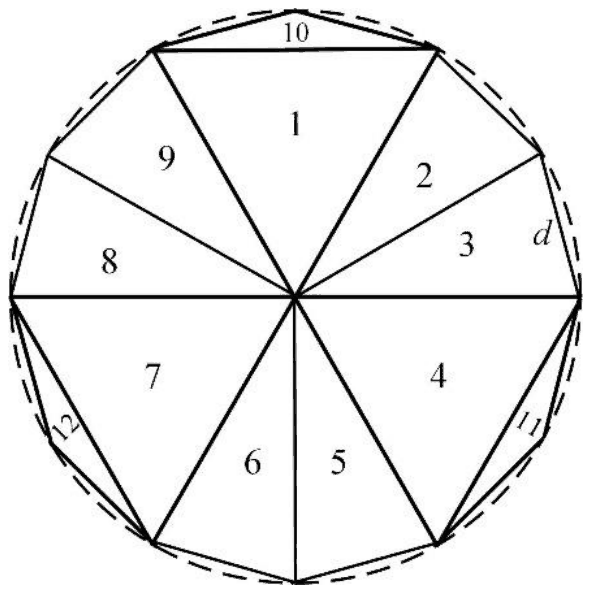
A regular dodecagon (12-sided regular polygon) is inscribed in a circle of radius r cm as shown in the figure. The side of the dodecagon is d cm. All the triangles (numbered 1 to 12) in the figure are used to form squares of side r cm and each numbered triangle is used only once to form a square.
The number of squares that can be formed and the number of triangles required to form each square, respectively, are:
Note: The figure shown is representative.
Answer: A
The answer is 3 squares, with 4 triangles each.
The dodecagon is made of 12 central triangles with apex angle 30 degrees, so its area is
\[ 12 \times \tfrac{1}{2} r^2 \sin 30^{\circ} = 3r^2, \]
exactly three squares of side r. Twelve triangles shared among 3 squares means 4 per square.
The pieces do fit that way. Triangles 1, 4 and 7 are equilateral with side r (area \(\frac{\sqrt{3}}{4}r^2\)), each thin edge triangle 10, 11, 12 has area \(\frac{2 - \sqrt{3}}{4}r^2\), and the six 30-degree triangles have area \(\frac{1}{4}r^2\) each. One equilateral, one thin and two 30-degree triangles total \(r^2\). 4 squares would need more area than the dodecagon has, and 3 or 2 triangles per square would leave pieces over.
Post your comment
Please log in or register to post a comment.
Examination Categories
- SSC Exams
- Banking Exams
- Teaching Exams
- Civil Services Exams
- Railways Exams
- Engineering Recruitment Exams
- Defence Exams
- State Government Exams
- Police Exams
- Insurance Exams
- Nursing Exams
- Other Government Exams
- NRA CET
- PG Entrance Exams
- Campus Placement
- MBA Entrance Exams
- CUET and UG Entrance
- Judiciary Exams
- Regulatory Body Exams
- Software Development