
Discussion
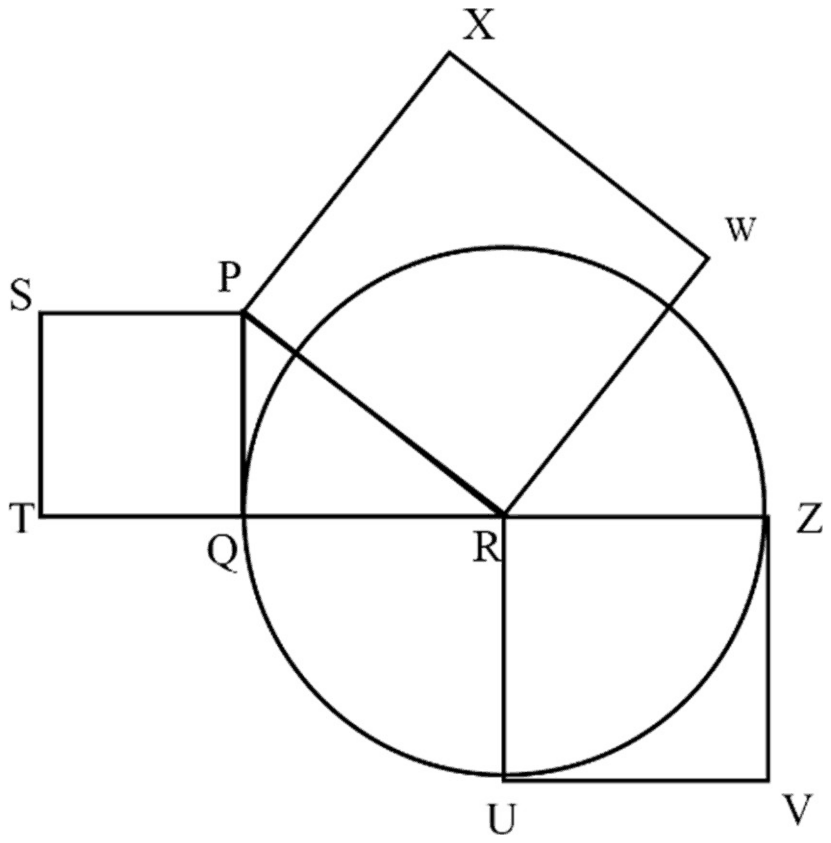
In the following diagram, the point R is the center of the circle. The lines PQ and ZV are tangential to the circle. The relation among the areas of the squares, PXWR, RUVZ and SPQT is
Answer: B
The relation is Area of SPQT = Area of PXWR − Area of RUVZ.
PQ is tangent to the circle at Q, so the radius RQ is perpendicular to PQ and triangle PQR is right-angled at Q. By Pythagoras, \(PR^{2} = PQ^{2} + QR^{2}\).
The square PXWR is built on PR, so its area is \(PR^{2}\). The square SPQT is built on PQ, area \(PQ^{2}\). The square RUVZ has sides RU and RZ, both radii, so its area is \(QR^{2}\) (QR is also a radius). Hence
\[ PQ^{2} = PR^{2} - QR^{2} \]
that is SPQT = PXWR − RUVZ. The three areas cannot all be equal, since PR is the hypotenuse and longer than both PQ and QR; the other two options subtract the wrong pair.
Post your comment
Please log in or register to post a comment.
Examination Categories
- SSC Exams
- Banking Exams
- Teaching Exams
- Civil Services Exams
- Railways Exams
- Engineering Recruitment Exams
- Defence Exams
- State Government Exams
- Police Exams
- Insurance Exams
- Nursing Exams
- Other Government Exams
- NRA CET
- PG Entrance Exams
- Campus Placement
- MBA Entrance Exams
- CUET and UG Entrance
- Judiciary Exams
- Regulatory Body Exams
- Software Development