
Discussion
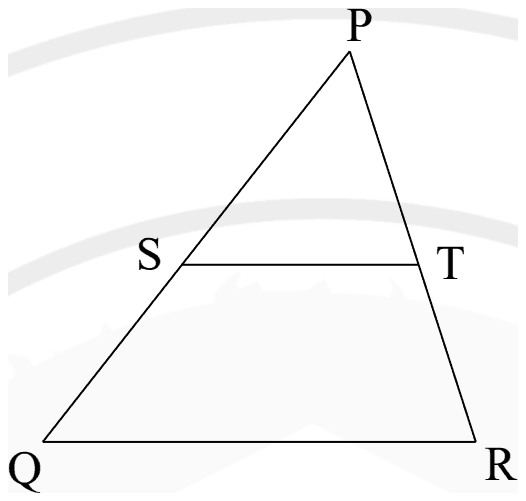
In the diagram, the lines QR and ST are parallel to each other. The shortest distance between these two lines is half the shortest distance between the point P and line QR. What is the ratio of the area of the triangle PST to the area of the trapezium SQRT?
Note: The figure shown is representative.
Answer: A
The ratio is \(\dfrac{1}{3}\).
Let the distance from P to QR be h. ST is parallel to QR at distance h/2 from it, so it is also h/2 from P. Triangles PST and PQR are therefore similar with ratio 1 : 2, and areas of similar figures scale as the square of the ratio:
\[ \begin{aligned} \frac{[PST]}{[PQR]} &= \left(\frac{1}{2}\right)^{2} = \frac{1}{4} \\ [SQRT] &= [PQR] - [PST] = \frac{3}{4}[PQR] \\ \frac{[PST]}{[SQRT]} &= \frac{1/4}{3/4} = \frac{1}{3} \end{aligned} \]
1/4 is the ratio of the small triangle to the whole triangle, not to the trapezium. 1/2 confuses the ratio of lengths with the ratio of areas, and 2/5 matches no step of the working.
Post your comment
Please log in or register to post a comment.
Examination Categories
- SSC Exams
- Banking Exams
- Teaching Exams
- Civil Services Exams
- Railways Exams
- Engineering Recruitment Exams
- Defence Exams
- State Government Exams
- Police Exams
- Insurance Exams
- Nursing Exams
- Other Government Exams
- NRA CET
- PG Entrance Exams
- Campus Placement
- MBA Entrance Exams
- CUET and UG Entrance
- Judiciary Exams
- Regulatory Body Exams
- Software Development