
Discussion
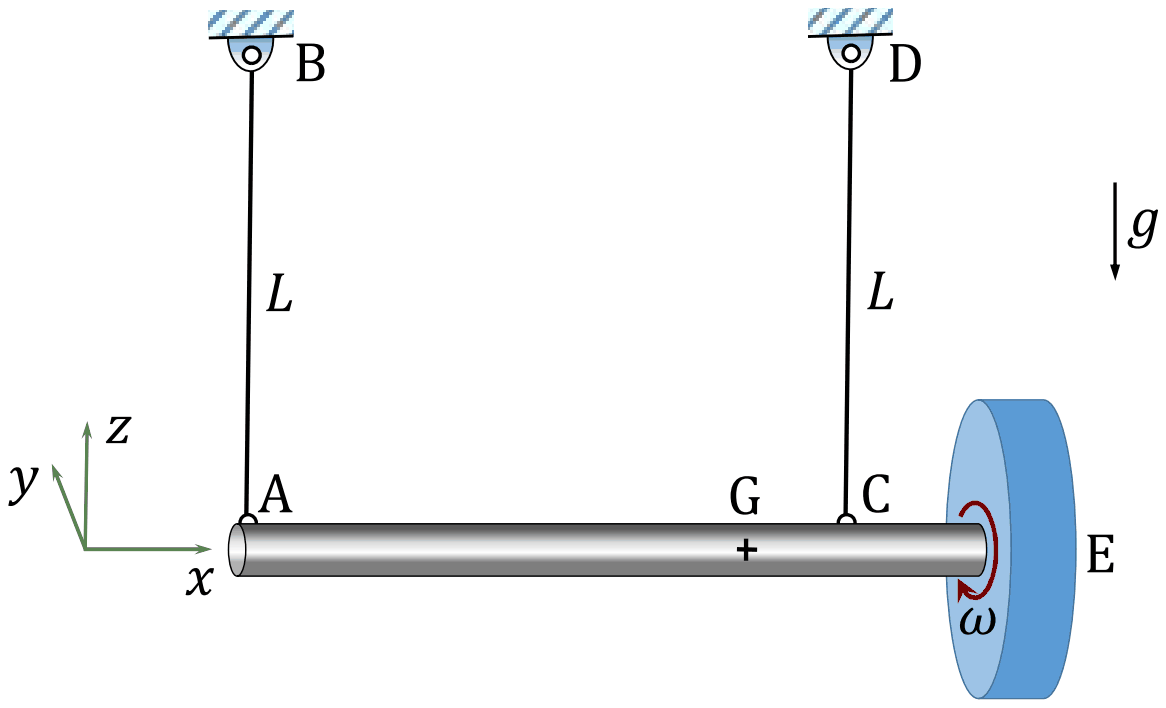
A massive uniform rigid circular disc is mounted on a frictionless bearing at the end E of a massive uniform rigid shaft AE which is suspended horizontally in a uniform gravitational field by two identical light inextensible strings AB and CD as shown, where G is the center of mass of the shaft-disc assembly and \(g\) is the acceleration due to gravity. The disc is then given a rapid spin \(\omega\) about its axis in the positive x-axis direction as shown, while the shaft remains at rest. The direction of rotation is defined by using the right-hand thumb rule. If the string AB is suddenly cut, assuming negligible energy dissipation, the shaft AE will
Answer: A
The shaft will rotate slowly about the negative z-axis direction: once AB is cut, the spinning disc makes the assembly precess about the vertical through C instead of falling.
With AB gone, string CD alone holds the assembly. G lies between A and C, so the weight \(W\) acts a distance \(a\) on the negative-x side of C. Taking x towards E, z up and y completing a right-handed set, the gravity torque about C is
\[ \begin{aligned} \vec{\tau} &= (-a\hat{i}) \times (-W\hat{k}) \\ &= aW(\hat{i} \times \hat{k}) = -aW\hat{j} \end{aligned} \]
The spin angular momentum is \(\vec{H} = I\omega\hat{i}\). For steady precession at rate \(\Omega\hat{k}\), \(\vec{\Omega} \times \vec{H} = \vec{\tau}\):
\[ \begin{aligned} \Omega I\omega\,(\hat{k} \times \hat{i}) &= \Omega I\omega\,\hat{j} \\ &= -aW\hat{j} \end{aligned} \]
so \(\Omega = -aW/(I\omega)\): rotation about the negative z axis, and slow because the rate falls as \(\omega\) rises.
Rotation about the y axis would be the shaft simply swinging down under gravity, which is what happens without the spin. The positive z direction would need the spin, or G's side of C, to be reversed.
Post your comment
Please log in or register to post a comment.
Examination Categories
- SSC Exams
- Banking Exams
- Teaching Exams
- Civil Services Exams
- Railways Exams
- Engineering Recruitment Exams
- Defence Exams
- State Government Exams
- Police Exams
- Insurance Exams
- Nursing Exams
- Other Government Exams
- NRA CET
- PG Entrance Exams
- Campus Placement
- MBA Entrance Exams
- CUET and UG Entrance
- Judiciary Exams
- Regulatory Body Exams
- Software Development