
Discussion
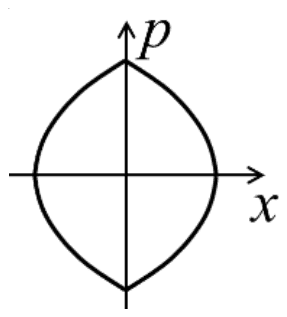
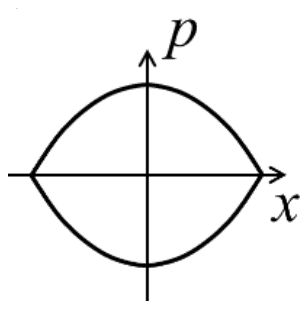
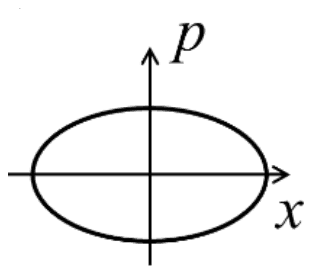
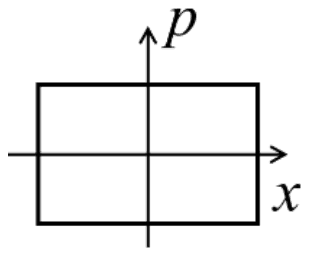
A particle moves in one dimension under a potential \(V(x) = \alpha|x|\) with some non-zero total energy. Which one of the following best describes the particle trajectory in the phase space?
- A.
- B.
- C.
- D.
Answer: A
The phase-space trajectory is sketch (A): smooth where it crosses the \(x\) axis and pointed where it crosses the \(p\) axis.
Energy conservation gives \(E = p^{2}/2m + \alpha|x|\), so
\[ |x| = \frac{1}{\alpha}\left(E - \frac{p^{2}}{2m}\right) \]
For \(x \gt 0\) and for \(x \lt 0\) the curve is a parabola in \(p\), opening toward the origin with its vertex on the \(x\) axis at \(x = \pm E/\alpha\), where it is smooth. The two parabolic arcs meet on the \(p\) axis at \(p = \pm\sqrt{2mE}\) at an angle, making corners there; this is because the force \(-\alpha\,\text{sgn}(x)\) jumps at \(x = 0\).
Sketch (B) has the corners on the \(x\) axis instead. The ellipse (C) is the harmonic oscillator, \(V \propto x^{2}\), and the rectangle (D) is a particle bouncing in an infinite square well, where \(|p|\) is constant.
Post your comment
Please log in or register to post a comment.
Examination Categories
- SSC Exams
- Banking Exams
- Teaching Exams
- Civil Services Exams
- Railways Exams
- Engineering Recruitment Exams
- Defence Exams
- State Government Exams
- Police Exams
- Insurance Exams
- Nursing Exams
- Other Government Exams
- NRA CET
- PG Entrance Exams
- Campus Placement
- MBA Entrance Exams
- CUET and UG Entrance
- Judiciary Exams
- Regulatory Body Exams
- Software Development