
Discussion
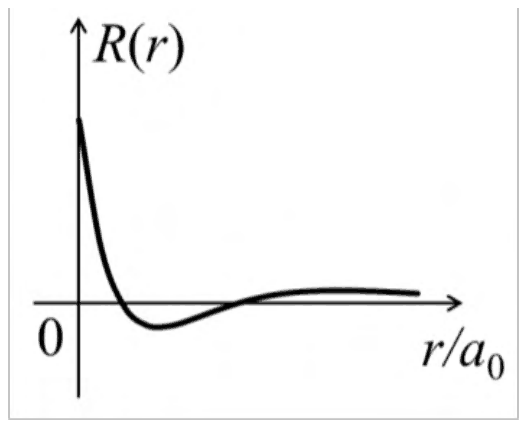
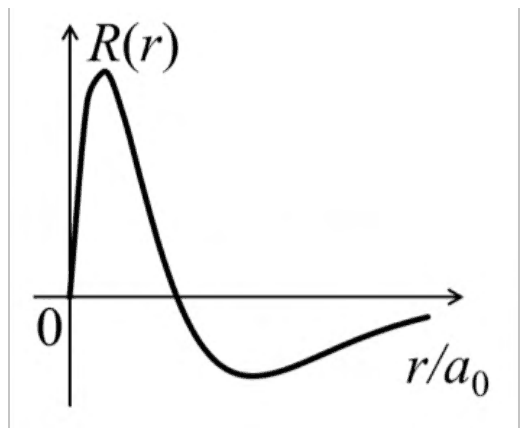
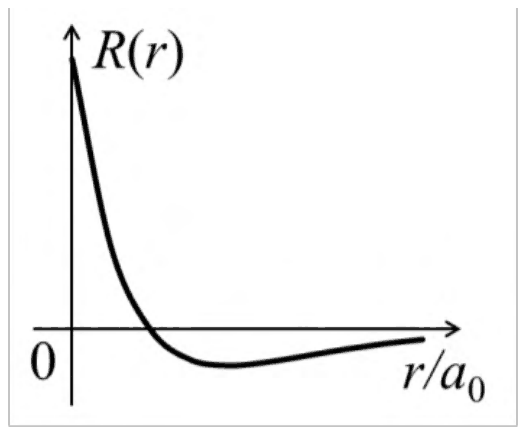
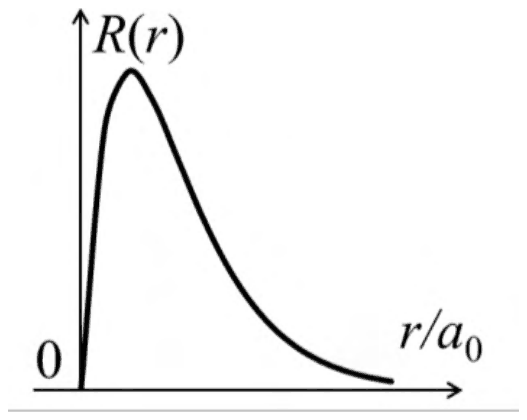
Which one of the following represents the \(3p\) radial wave function of hydrogen atom? (\(a_{0}\) is the Bohr radius)
- A.
- B.
- C.
- D.
Answer: B
The 3p radial function is sketch (B).
A hydrogen radial function \(R_{nl}\) has \(n - l - 1\) radial nodes and behaves as \(r^{l}\) near the origin. For 3p, \(n = 3\) and \(l = 1\), so
\[ \begin{aligned} R_{31} &\propto \frac{r}{a_{0}}\left(1 - \frac{r}{6a_{0}}\right) \\ &\quad \times e^{-r/3a_{0}} \end{aligned} \]
It is zero at \(r = 0\), rises to a positive maximum, crosses zero once at \(r = 6a_{0}\), dips negative and decays to zero. Sketch (B) shows exactly this.
Sketches (A) and (C) are non-zero at the origin, which only s states (\(l = 0\)) do: (A), with two nodes, is the 3s function and (C), with one node, is 2s. Sketch (D) starts at zero but has no node, which is the 2p function.
Post your comment
Please log in or register to post a comment.
Examination Categories
- SSC Exams
- Banking Exams
- Teaching Exams
- Civil Services Exams
- Railways Exams
- Engineering Recruitment Exams
- Defence Exams
- State Government Exams
- Police Exams
- Insurance Exams
- Nursing Exams
- Other Government Exams
- NRA CET
- PG Entrance Exams
- Campus Placement
- MBA Entrance Exams
- CUET and UG Entrance
- Judiciary Exams
- Regulatory Body Exams
- Software Development