
Discussion
The adaptive immune response in an animal involves the generation of antibodies against an invading bacterial pathogen. The following graph represents antibody titer levels in a mammal exposed twice to the pathogen.
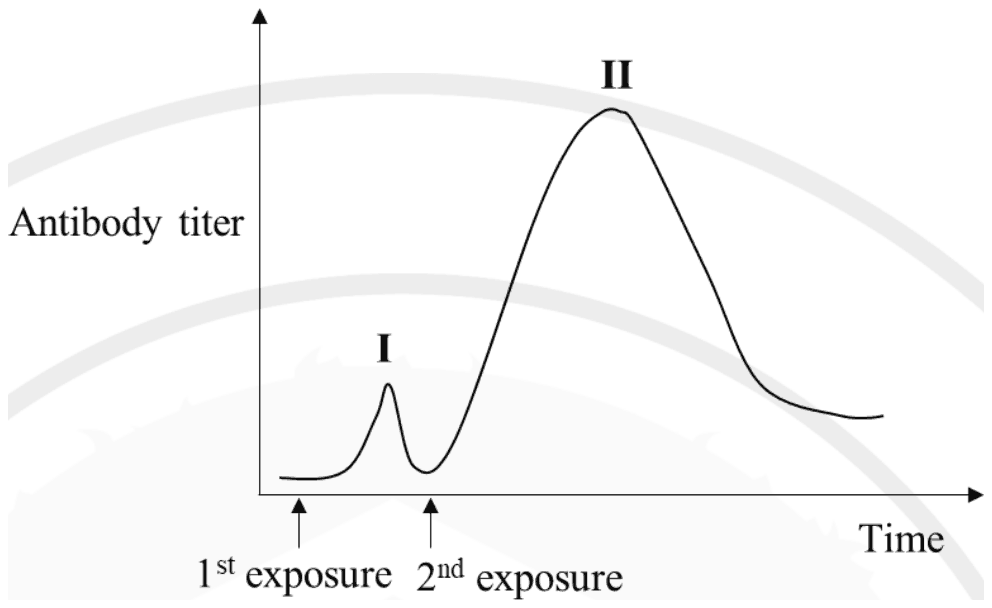
Which one of the following options correctly pairs antibodies to peak I and peak II in the graph?
Answer: B
The pairing is Peak I - IgM; Peak II - IgG.
Peak I is the primary response, after the first exposure: it is small and appears after a lag, and its antibody is mainly IgM, the first class made by naive B cells. During that response B cells undergo class switching and form memory cells.
Peak II is the secondary response. Memory B cells respond quickly to the second exposure and produce a much larger and longer-lasting titre, made up mainly of high-affinity IgG.
IgG first and IgM second reverses the order of class switching. IgE is the antibody of allergy and anti-parasite responses, not of the primary response to a bacterium. IgG for both peaks ignores the IgM that dominates a primary response.
Post your comment
Please log in or register to post a comment.
Examination Categories
- SSC Exams
- Banking Exams
- Teaching Exams
- Civil Services Exams
- Railways Exams
- Engineering Recruitment Exams
- Defence Exams
- State Government Exams
- Police Exams
- Insurance Exams
- Nursing Exams
- Other Government Exams
- NRA CET
- PG Entrance Exams
- Campus Placement
- MBA Entrance Exams
- CUET and UG Entrance
- Judiciary Exams
- Regulatory Body Exams
- Software Development