
Discussion
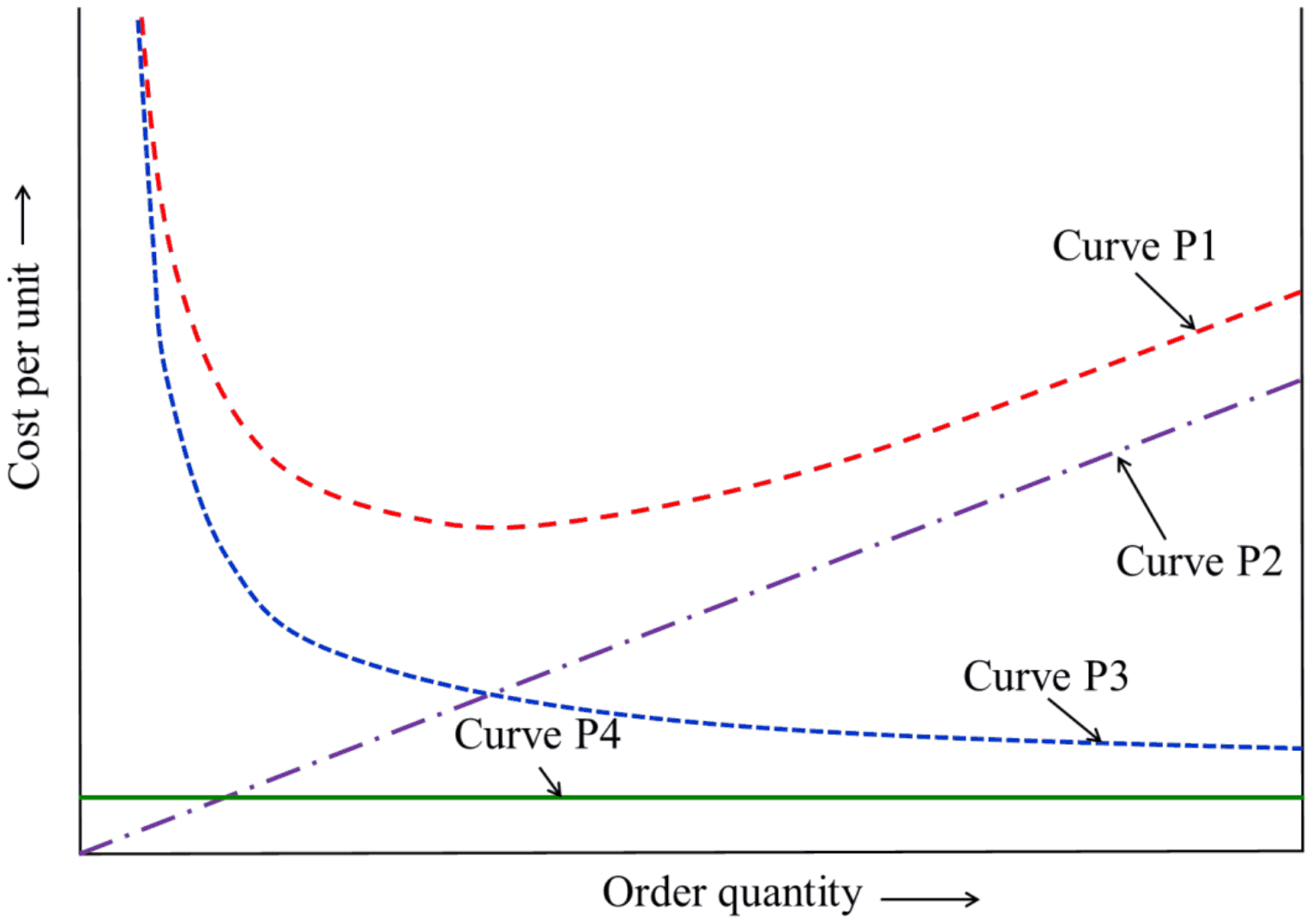
With reference to the Economic Order Quantity (EOQ) model, which one of the options given is correct?
Answer: A
The correct labelling is Curve P1: Total cost, Curve P2: Holding cost, Curve P3: Setup cost, and Curve P4: Production cost.
In the EOQ model, with order quantity Q, annual demand D, setup cost S per order and holding cost H per unit per year:
- holding cost rises in a straight line with Q, since average stock is Q/2: the dash-dot line P2 through the origin;
- setup (ordering) cost falls as D/Q, steeply at first and then flattening: the hyperbola-like curve P3;
- production or purchase cost per unit does not depend on the order quantity: the flat line P4;
- total cost, the sum of these, is U-shaped with its minimum near where the holding and setup curves cross, at the EOQ: P1.
Every other option gives a straight or flat curve the name of a cost that must curve, or swaps the U-shaped total with a component.
No comment is present. Be the first to comment.
Loading…
Post your comment
Please log in or register to post a comment.
Examination Categories
- SSC Exams
- Banking Exams
- Teaching Exams
- Civil Services Exams
- Railways Exams
- Engineering Recruitment Exams
- Defence Exams
- State Government Exams
- Police Exams
- Insurance Exams
- Nursing Exams
- Other Government Exams
- NRA CET
- PG Entrance Exams
- Campus Placement
- MBA Entrance Exams
- CUET and UG Entrance
- Judiciary Exams
- Regulatory Body Exams
- Software Development