
Discussion
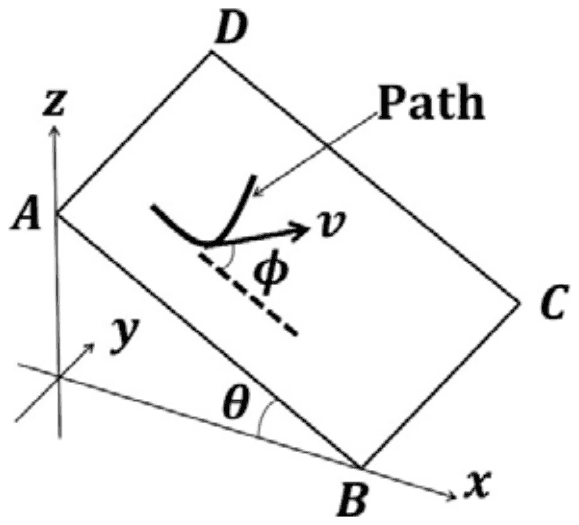
A particle is constrained to move at a constant speed on an inclined plane (ABCD) along the curved path shown in the figure. Edges AD and BC are parallel to the \(y\) axis. The inclined plane makes an angle \(\theta\) with the \(xy\)-plane. The velocity vector of the particle makes an angle \(\phi\) with the dotted line which is parallel to edge \(AB\). If the speed of the particle is 2 m/s, \(\phi = 30^{\circ}\), and \(\theta = 40^{\circ}\), then the \(z\)-component of the velocity of the particle in m/s is __________
Answer: C
The z-component is \(-1.11\) m/s.
The velocity lies in the plane. Split it along the dotted line parallel to AB, which is the line of steepest slope at angle \(\theta\) to the xy-plane, and along the y direction, which is horizontal. Only the AB component has a vertical part, and the particle moves down the slope:
\[ \begin{aligned} v_{z} &= -v\cos\phi\sin\theta \\ &= -2 \times \cos 30^{\circ} \times \sin 40^{\circ} \\ &= -2 \times 0.866 \times 0.643 = -1.11 \end{aligned} \]
\(-1.32\) uses \(\cos 40^{\circ}\) in place of \(\sin 40^{\circ}\), \(-1.00\) is \(-v\sin\phi\), which ignores the slope altogether, and \(-1.50\) does not follow from these angles.
Post your comment
Please log in or register to post a comment.
Examination Categories
- SSC Exams
- Banking Exams
- Teaching Exams
- Civil Services Exams
- Railways Exams
- Engineering Recruitment Exams
- Defence Exams
- State Government Exams
- Police Exams
- Insurance Exams
- Nursing Exams
- Other Government Exams
- NRA CET
- PG Entrance Exams
- Campus Placement
- MBA Entrance Exams
- CUET and UG Entrance
- Judiciary Exams
- Regulatory Body Exams
- Software Development