
Discussion
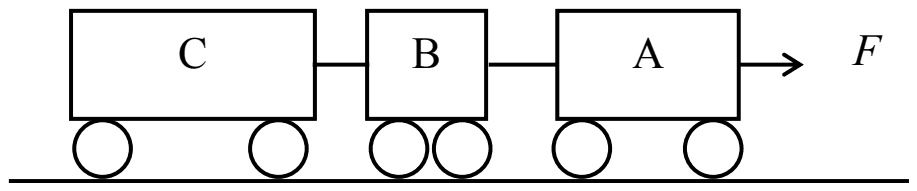
Three connected railway coaches A, B and C of masses \(m_{A}\), \(m_{B}\) and \(m_{C}\), respectively are being pulled by a locomotive with force F over a horizontal track. The coaches may be assumed to move on frictionless wheels with negligible air resistance. The tension in the connector between coaches A and B is
Answer: D
The tension between A and B is \(F(m_{B} + m_{C})/(m_{A} + m_{B} + m_{C})\).
The whole train accelerates together at
\[ a = \frac{F}{m_{A} + m_{B} + m_{C}} \]
The coupling between A and B is the only horizontal force on the rear part of the train, coaches B and C together, so it must give them this acceleration:
\[ \begin{aligned} T_{AB} &= (m_{B} + m_{C})a \\ &= \frac{F(m_{B} + m_{C})}{m_{A} + m_{B} + m_{C}} \end{aligned} \]
F would be the tension only if B and C were massless. \(Fm_{A}/(\ldots)\) is the net force on A, and \(Fm_{B}/(\ldots)\) is the net force on B alone.
Post your comment
Please log in or register to post a comment.
Examination Categories
- SSC Exams
- Banking Exams
- Teaching Exams
- Civil Services Exams
- Railways Exams
- Engineering Recruitment Exams
- Defence Exams
- State Government Exams
- Police Exams
- Insurance Exams
- Nursing Exams
- Other Government Exams
- NRA CET
- PG Entrance Exams
- Campus Placement
- MBA Entrance Exams
- CUET and UG Entrance
- Judiciary Exams
- Regulatory Body Exams
- Software Development