
Discussion
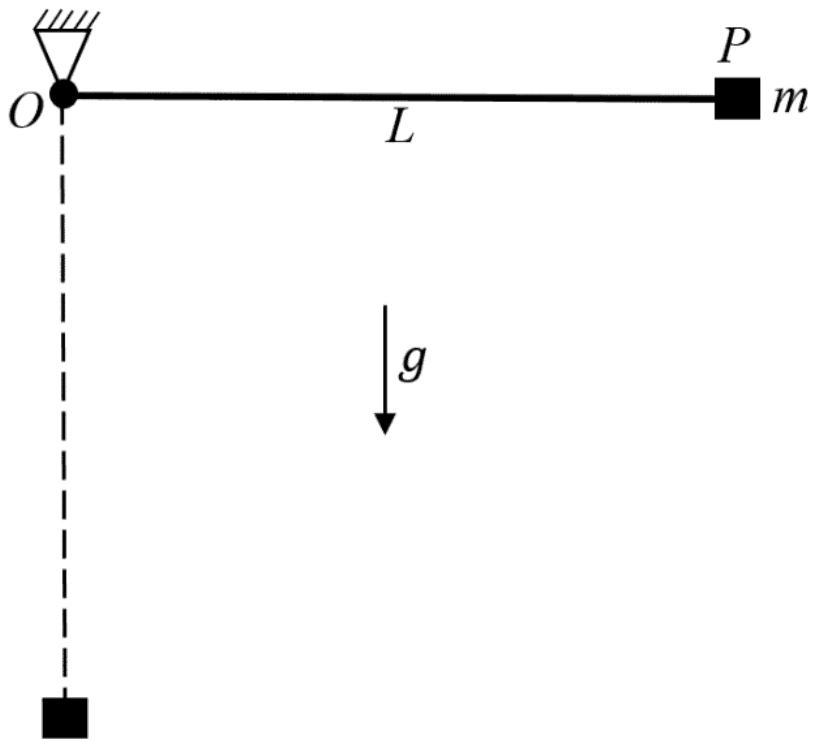
A massless rigid rod \(OP\) of length \(L\) is hinged frictionlessly at \(O\). A concentrated mass \(m\) is attached to end \(P\) of the rod. Initially, the rod \(OP\) is horizontal. Then, it is released from rest. There is gravity as shown. The rod acquires an angular velocity as it swings. The clockwise angular velocity of the rod, when it first reaches the vertical position as shown, is
Answer: B
The angular velocity is \(\sqrt{\frac{2g}{L}}\).
The hinge is frictionless and the rod massless, so mechanical energy is conserved. Swinging from horizontal to vertical, the mass falls a height \(L\), and in the vertical position it moves on a circle of radius \(L\) with speed \(\omega L\):
\[ \begin{aligned} mgL &= \tfrac{1}{2}m(\omega L)^{2} \\ \omega^{2} &= \tfrac{2g}{L} \\ \omega &= \sqrt{\tfrac{2g}{L}} \end{aligned} \]
\(\sqrt{g/L}\) drops the factor 2 from the kinetic energy, \(2\sqrt{g/L}\) is the speed for a fall of \(2L\), and \(\frac{1}{2}\sqrt{g/L}\) has no consistent derivation.
Post your comment
Please log in or register to post a comment.
Examination Categories
- SSC Exams
- Banking Exams
- Teaching Exams
- Civil Services Exams
- Railways Exams
- Engineering Recruitment Exams
- Defence Exams
- State Government Exams
- Police Exams
- Insurance Exams
- Nursing Exams
- Other Government Exams
- NRA CET
- PG Entrance Exams
- Campus Placement
- MBA Entrance Exams
- CUET and UG Entrance
- Judiciary Exams
- Regulatory Body Exams
- Software Development