
Discussion
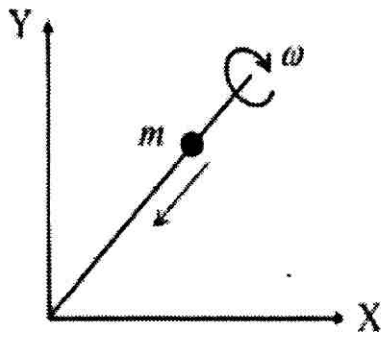
A bead of mass m slides on a smooth massless rod. The rod is rotating about one end in X-Y plane with uniform angular velocity ω (as shown in the figure). The Lagrangian of the system is given as :
Answer: C
The Lagrangian is \(L = \frac{1}{2}m(\dot{r}^{2} + r^{2}\dot{\theta}^{2}) - mgr\sin\theta\).
Use polar coordinates \((r, \theta)\) in the vertical X-Y plane, with \(\theta\) measured from the X axis and Y upward. The bead slides along the rod, so \(r\) changes, and it turns with the rod at \(\dot{\theta} = \omega\). Its kinetic energy has radial and transverse parts:
\[ \begin{aligned} T &= \tfrac{1}{2}m(\dot{r}^{2} + r^{2}\dot{\theta}^{2}) \\ V &= mgy = mgr\sin\theta \end{aligned} \]
\(L = T - V\) gives the third option. The first two drop the radial kinetic energy \(\frac{1}{2}m\dot{r}^{2}\), which is essential since the bead slides. The last adds the potential energy and uses \(\cos\theta\), which would measure height from the Y axis.
Post your comment
Please log in or register to post a comment.
Examination Categories
- SSC Exams
- Banking Exams
- Teaching Exams
- Civil Services Exams
- Railways Exams
- Engineering Recruitment Exams
- Defence Exams
- State Government Exams
- Police Exams
- Insurance Exams
- Nursing Exams
- Other Government Exams
- NRA CET
- PG Entrance Exams
- Campus Placement
- MBA Entrance Exams
- CUET and UG Entrance
- Judiciary Exams
- Regulatory Body Exams
- Software Development