
Discussion
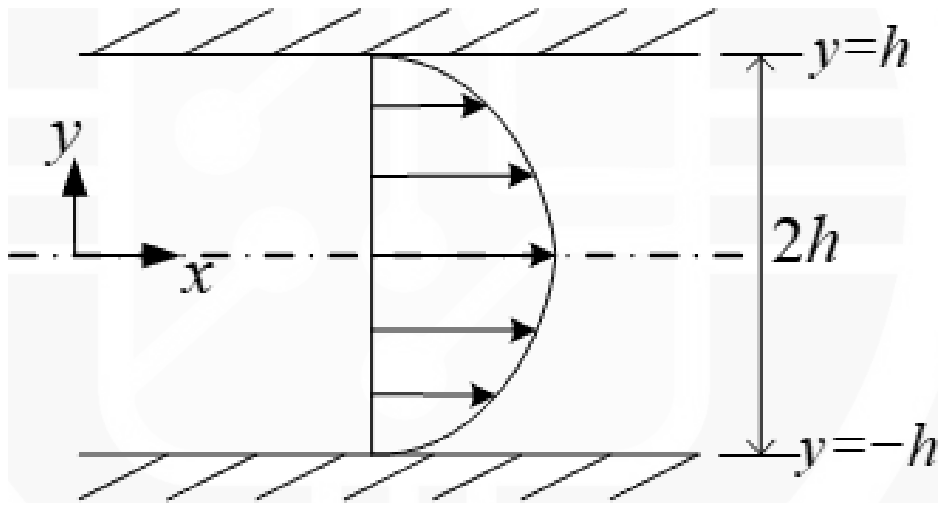
A steady, laminar, and incompressible flow between a pair of infinite parallel plates is driven by a constant pressure gradient \((-dp/dx)\). The plates are separated by a distance 2h, as shown in the figure. The fully-developed velocity profile of the flow is
\[ \begin{aligned} u(y) = &-\frac{dp}{dx}\frac{h^{2}}{2\mu} \\ &\times\left(1-\frac{y^{2}}{h^{2}}\right), \end{aligned} \]
where \(\mu\) is the dynamic viscosity.
The values of y, for which the local flow velocity is equal to the average flow velocity, are
Answer: D
The local velocity equals the average at \(y = \pm\frac{h}{\sqrt{3}}\).
Write the profile as \(u = u_{max}(1-y^{2}/h^{2})\). Its average across the gap is:
\[ \begin{aligned} \bar{u} &= \frac{1}{2h}\int_{-h}^{h}u_{max}\left(1-\frac{y^{2}}{h^{2}}\right)dy \\ &= \frac{2}{3}u_{max} \end{aligned} \]
Setting the local velocity equal to it:
\[ \begin{aligned} 1-\frac{y^{2}}{h^{2}} &= \frac{2}{3} \\ y &= \pm\frac{h}{\sqrt{3}} \approx \pm 0.577h \end{aligned} \]
\(\pm h/\sqrt{2}\) is where the velocity is half the maximum, and \(\pm h/2\) and \(\pm h/3\) give 3/4 and 8/9 of the maximum.
Post your comment
Please log in or register to post a comment.
Examination Categories
- SSC Exams
- Banking Exams
- Teaching Exams
- Civil Services Exams
- Railways Exams
- Engineering Recruitment Exams
- Defence Exams
- State Government Exams
- Police Exams
- Insurance Exams
- Nursing Exams
- Other Government Exams
- NRA CET
- PG Entrance Exams
- Campus Placement
- MBA Entrance Exams
- CUET and UG Entrance
- Judiciary Exams
- Regulatory Body Exams
- Software Development