
Discussion
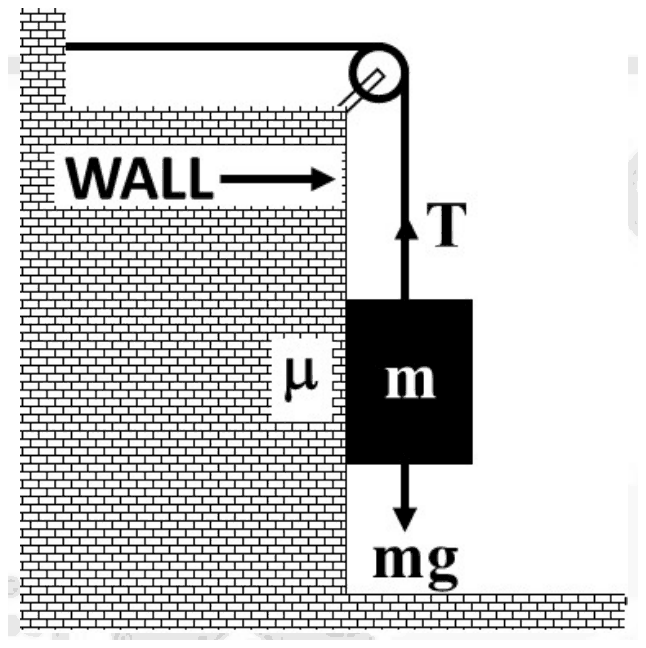
Consider a block of mass 'm' hanging using a string and pulley arrangement, as shown in the figure. The weight 'mg' and tension 'T' are working on the block in such a way that the block is not moving and the string is parallel to the perfectly vertical wall. If the block is just in contact (but not attached/fixed) with the wall and the coefficient of static friction is 'μ', then the static frictional force acting on the block is
Answer: A
The static frictional force is 0.
Friction between two surfaces depends on the normal force pressing them together. Here the string is vertical, so both forces on the block, the tension T upwards and the weight mg downwards, are vertical. No horizontal force pushes the block into the wall, so the normal reaction from the wall is zero, and so is any friction.
There is also no tendency to slide: the block is at rest with \(T = mg\), so nothing is left for friction to balance. The other options multiply \(\mu\) by a vertical force. That confuses the weight or tension with the normal force, and in any case \(\mu N\) is only the largest static friction possible, not the friction actually acting.
Post your comment
Please log in or register to post a comment.
Examination Categories
- SSC Exams
- Banking Exams
- Teaching Exams
- Civil Services Exams
- Railways Exams
- Engineering Recruitment Exams
- Defence Exams
- State Government Exams
- Police Exams
- Insurance Exams
- Nursing Exams
- Other Government Exams
- NRA CET
- PG Entrance Exams
- Campus Placement
- MBA Entrance Exams
- CUET and UG Entrance
- Judiciary Exams
- Regulatory Body Exams
- Software Development