
Discussion
The wire loop shown in the figure carries a steady current \(I\). Each straight section of the loop has length \(d\). A part of the loop lies in \(xy\) plane and the other part is tilted at 30° with respect to the \(xz\) plane. The magnitude of the magnetic dipole moment of the loop (in appropriate units) is
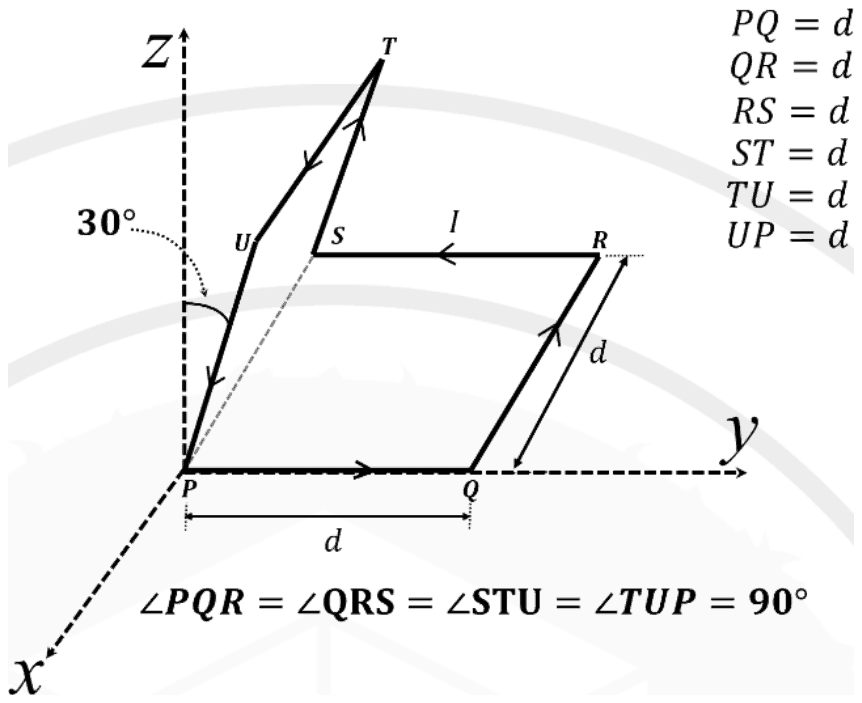
Answer: D
The magnitude of the dipole moment is \(Id^{2}\).
Add and subtract the side PS (from S to P): the loop P-Q-R-S-T-U-P is then the sum of two square loops, PQRS in the \(xy\) plane and PSTU in the tilted plane, each of area \(d^{2}\), with the shared side cancelling.
PQRS, traversed P to Q (along \(+y\)) then Q to R (along \(-x\)), has moment \(Id^{2}\hat{z}\). PSTU contains PS (along \(-x\)) and PU, which leans 30° from the \(z\)-axis towards \(+y\); its moment is perpendicular to its plane:
\[ \begin{aligned} \vec{m}_{2} &= Id^{2}(\cos 30^{\circ}\hat{y} - \sin 30^{\circ}\hat{z}) \\ \vec{m} &= Id^{2}\left(\tfrac{\sqrt{3}}{2}\hat{y} + \tfrac{1}{2}\hat{z}\right) \\ |\vec{m}| &= Id^{2} \end{aligned} \]
Adding the two squares' moments as if they were perpendicular gives \(\sqrt{2}Id^{2}\), and as if parallel \(2Id^{2}\); they are in fact 120° apart, so the resultant has the magnitude of either one.
Post your comment
Please log in or register to post a comment.
Examination Categories
- SSC Exams
- Banking Exams
- Teaching Exams
- Civil Services Exams
- Railways Exams
- Engineering Recruitment Exams
- Defence Exams
- State Government Exams
- Police Exams
- Insurance Exams
- Nursing Exams
- Other Government Exams
- NRA CET
- PG Entrance Exams
- Campus Placement
- MBA Entrance Exams
- CUET and UG Entrance
- Judiciary Exams
- Regulatory Body Exams
- Software Development