
Discussion
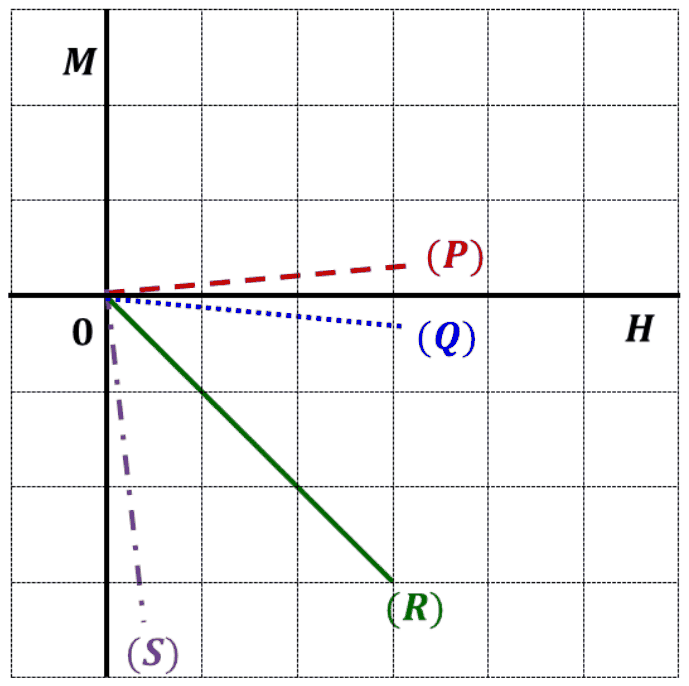
The figure schematically shows the \(M\) (magnetization) - \(H\) (magnetic field) plots for certain types of materials. Here \(M\) and \(H\) are plotted in the same scale and units. Which one of the following is the most appropriate combination?
Answer: B
The combination is (P) - Paramagnet; (Q) - Diamagnet; (R) - Type-I Superconductor.
The slope of each line is the susceptibility \(\chi = M/H\). P has a small positive slope, the weak positive response of a paramagnet. Q has a small negative slope, the weak opposing response of a diamagnet. R has a slope of exactly -1, so \(M = -H\) and \(B = \mu_{0}(H + M) = 0\): perfect diamagnetism, the Meissner state of a Type-I superconductor.
S is steeper than -1, a susceptibility below -1, which no material shows in equilibrium. An antiferromagnet has a small positive susceptibility, so calling Q an antiferromagnet is wrong, and the options assigning S to an antiferromagnet or a Type-I superconductor, or calling P diamagnetic, fail as well.
Post your comment
Please log in or register to post a comment.
Examination Categories
- SSC Exams
- Banking Exams
- Teaching Exams
- Civil Services Exams
- Railways Exams
- Engineering Recruitment Exams
- Defence Exams
- State Government Exams
- Police Exams
- Insurance Exams
- Nursing Exams
- Other Government Exams
- NRA CET
- PG Entrance Exams
- Campus Placement
- MBA Entrance Exams
- CUET and UG Entrance
- Judiciary Exams
- Regulatory Body Exams
- Software Development