
Discussion
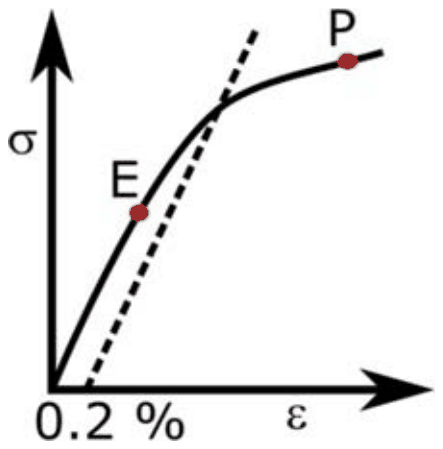
Refer to the schematic shown. Two dog-bone samples, labelled 1 and 2, of a Cu-alloy are tested under tension at room temperature to points “E” and “P”, respectively. Subsequently, they are unloaded completely and metallographically polished. Brinell hardness testing was performed in the gauge section of the samples. Which one of the following can be inferred about the measured Brinell hardness number (BHN)?
Answer: C
The inference is BHN of 1 \(\lt\) BHN of 2.
Point E lies on the linear elastic part of the curve, so sample 1 recovers completely on unloading and its microstructure is unchanged. Point P lies beyond the 0.2% offset yield point, so sample 2 has deformed plastically: the dislocation density has risen and the alloy has work hardened. After unloading, sample 2 keeps that strain hardening and so shows a higher Brinell hardness.
Polishing removes only the surface, not the bulk work hardening, so equal hardness is wrong; and enough information is given, since the two points sit on opposite sides of yield.
Post your comment
Please log in or register to post a comment.
Examination Categories
- SSC Exams
- Banking Exams
- Teaching Exams
- Civil Services Exams
- Railways Exams
- Engineering Recruitment Exams
- Defence Exams
- State Government Exams
- Police Exams
- Insurance Exams
- Nursing Exams
- Other Government Exams
- NRA CET
- PG Entrance Exams
- Campus Placement
- MBA Entrance Exams
- CUET and UG Entrance
- Judiciary Exams
- Regulatory Body Exams
- Software Development