
Discussion
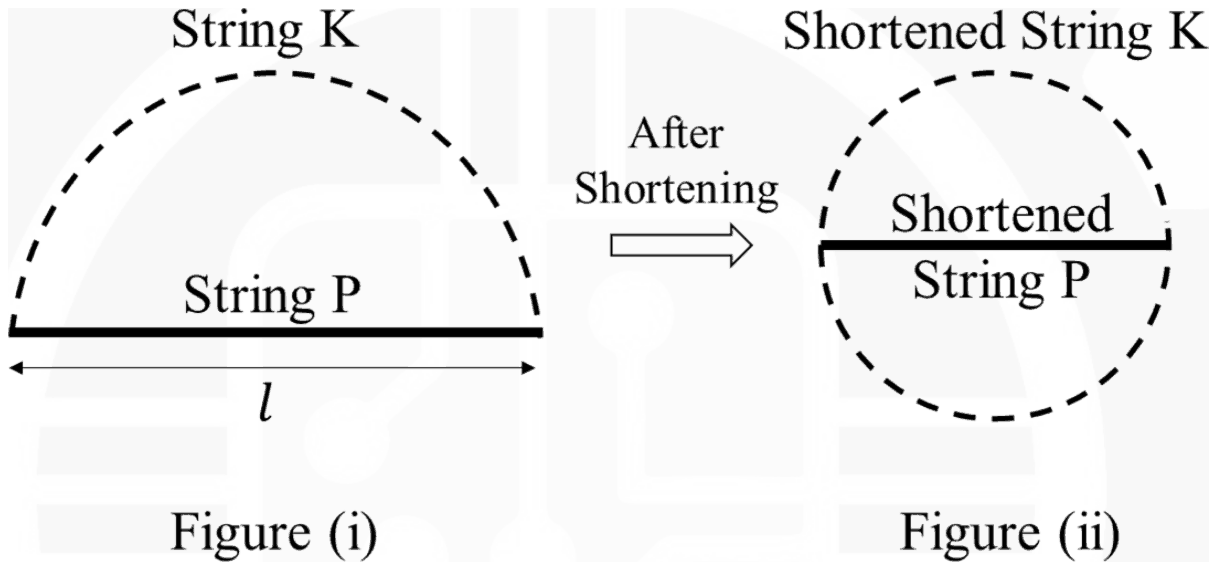
Consider a string P of length \(l\) that is laid out as a straight-line segment. Another string K is laid out as a semicircular arc with string P as its diameter, as represented in Figure (i). When both the strings are shortened by a length \(x\) they can be re-arranged such that the shortened string K forms a full circle with the shortened string P as its diameter, as represented in Figure (ii). The value of \(x/l\) is __________
Answer: C
The value is \(\frac{\pi}{2(\pi - 1)}\).
A semicircle on a diameter of length \(l\) has length \(\frac{\pi l}{2}\), so string K is \(\pi l/2\) long. After shortening, P has length \(l - x\) and K, \(\pi l/2 - x\), must equal the circumference of a circle of diameter \(l - x\):
\[ \begin{aligned} \frac{\pi l}{2} - x &= \pi(l - x) \\ \pi x - x &= \frac{\pi l}{2} \\ \frac{x}{l} &= \frac{\pi}{2(\pi - 1)} \end{aligned} \]
That is about 0.73, a sensible fraction of \(l\). \(\pi\) and \(\frac{\pi}{\pi - 1}\) exceed 1, which would shorten the strings by more than P's whole length, and \(\frac{\pi - 1}{2\pi}\) is not a solution of the equation.
Post your comment
Please log in or register to post a comment.
Examination Categories
- SSC Exams
- Banking Exams
- Teaching Exams
- Civil Services Exams
- Railways Exams
- Engineering Recruitment Exams
- Defence Exams
- State Government Exams
- Police Exams
- Insurance Exams
- Nursing Exams
- Other Government Exams
- NRA CET
- PG Entrance Exams
- Campus Placement
- MBA Entrance Exams
- CUET and UG Entrance
- Judiciary Exams
- Regulatory Body Exams
- Software Development