
Discussion
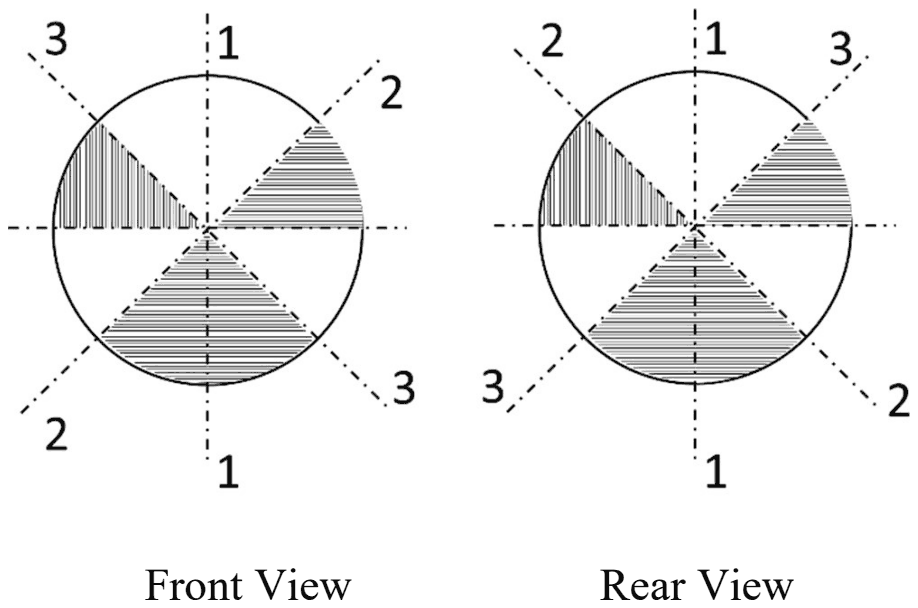
The figure below shows the front and rear view of a disc, which is shaded with identical patterns. The disc is flipped once with respect to any one of the fixed axes 1-1, 2-2 or 3-3 chosen uniformly at random.
What is the probability that the disc DOES NOT retain the same front and rear views after the flipping operation?
Answer: C
The probability is 2/3.
The disc shows the same pattern on both faces, and the rear view is that pattern as seen from behind. Flipping about an axis in the plane of the disc brings the back face to the front, reflected in that axis. Seen from the front, the new front view is the old pattern reflected first in the vertical line (because it was the back face) and then in the chosen axis.
For axis 1-1, which is vertical, the two reflections are the same and cancel, so the views are unchanged. For the diagonal axes 2-2 and 3-3, two reflections in different lines combine into a rotation of the disc, and the hatched sectors (a vertically hatched one upper left, horizontally hatched ones upper right and at the bottom) do not look the same after such a rotation.
So the views are lost for 2 of the 3 equally likely axes, giving 2/3. Answering 1/3 counts the one axis that keeps the views; 0 and 1 would need all or none of the axes to work.
Post your comment
Please log in or register to post a comment.
Examination Categories
- SSC Exams
- Banking Exams
- Teaching Exams
- Civil Services Exams
- Railways Exams
- Engineering Recruitment Exams
- Defence Exams
- State Government Exams
- Police Exams
- Insurance Exams
- Nursing Exams
- Other Government Exams
- NRA CET
- PG Entrance Exams
- Campus Placement
- MBA Entrance Exams
- CUET and UG Entrance
- Judiciary Exams
- Regulatory Body Exams
- Software Development