
Discussion
A line of symmetry is defined as a line that divides a figure into two parts in a way such that each part is a mirror image of the other part about that line.
The given figure consists of 16 unit squares arranged as shown. In addition to the three black squares, what is the minimum number of squares that must be coloured black, such that both PQ and MN form lines of symmetry? (The figure is representative)
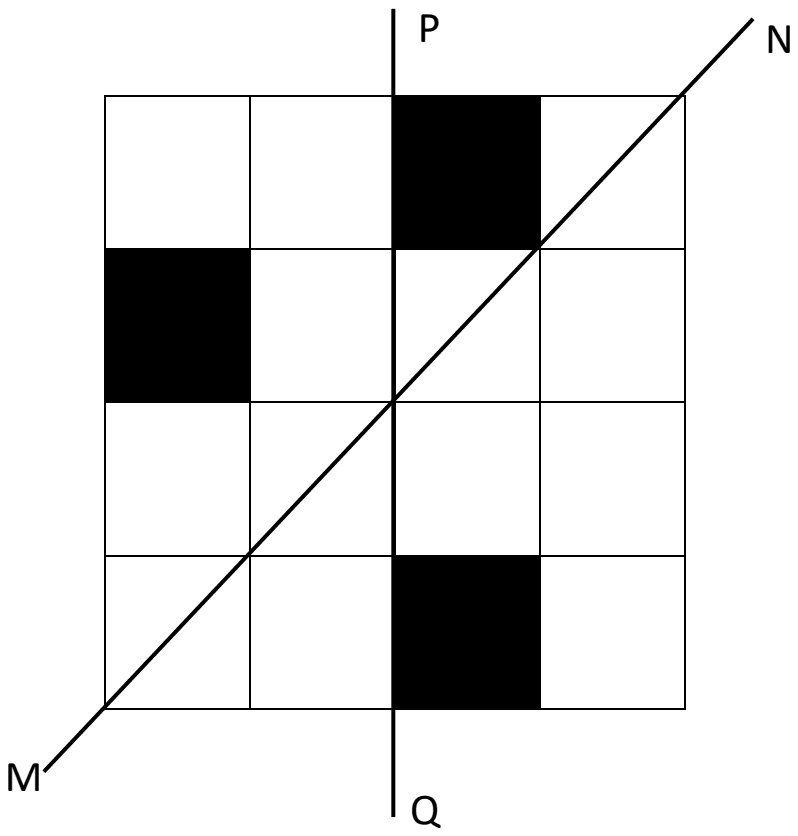
Answer: C
At least 5 more squares must be coloured.
Number the rows 1 to 4 from the top and the columns 1 to 4 from the left. The black squares are at (1, 3), (2, 1) and (4, 3). PQ is the vertical centre line, which swaps column \(c\) with column \(5 - c\). MN is the diagonal from the bottom left corner to the top right corner, which sends the square at (\(r\), \(c\)) to (\(5 - c\), \(5 - r\)).
Apply both reflections repeatedly to (1, 3): it reaches (1, 2), (2, 4), (3, 4), (4, 3), (4, 2), (3, 1) and (2, 1). These are the eight edge squares that are not corners, and all three black squares are among them. For both lines to be lines of symmetry, all eight must be black, so the five missing ones, (1, 2), (2, 4), (3, 1), (3, 4) and (4, 2), must be added.
3 or 4 would leave some black square without its mirror image, and 6 is more than needed.
Post your comment
Please log in or register to post a comment.
Examination Categories
- SSC Exams
- Banking Exams
- Teaching Exams
- Civil Services Exams
- Railways Exams
- Engineering Recruitment Exams
- Defence Exams
- State Government Exams
- Police Exams
- Insurance Exams
- Nursing Exams
- Other Government Exams
- NRA CET
- PG Entrance Exams
- Campus Placement
- MBA Entrance Exams
- CUET and UG Entrance
- Judiciary Exams
- Regulatory Body Exams
- Software Development