
Discussion
An object is said to have an \(n\)-fold rotational symmetry if the object, rotated by an angle of \(\frac{2\pi}{n}\), is identical to the original.
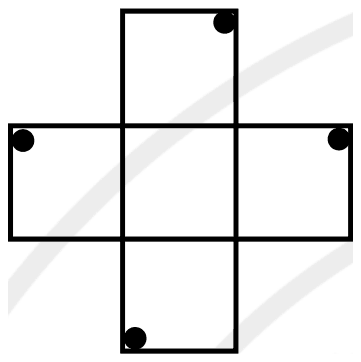
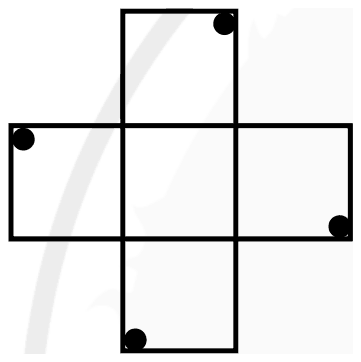
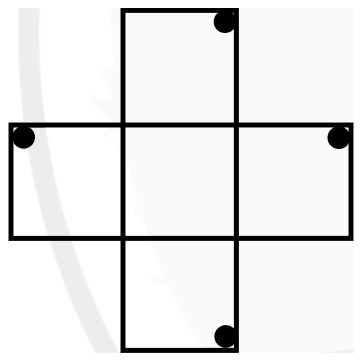
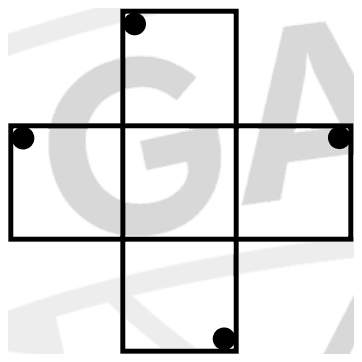
Which one of the following objects exhibits 4-fold rotational symmetry about an axis perpendicular to the plane of the screen?
Note: The figures shown are representative.
- A.
- B.
- C.
- D.
Answer: B
The object with 4-fold rotational symmetry is (B).
A 4-fold symmetry means a 90° rotation leaves the object unchanged, so each arm's dot must move onto the next arm's dot. In (B) the dots are at the top arm's outer right corner, the right arm's outer lower corner, the bottom arm's outer left corner and the left arm's outer upper corner. Turning the figure 90° clockwise carries each of these exactly onto the next, so (B) maps onto itself.
In (A) and (C) the left and right arms carry their dots on the same (upper) side, a mirror arrangement rather than a rotational one, so a 90° turn moves a dot to an empty corner. (D) has the same fault on the vertical arms. Each of these has at most a reflection or 2-fold symmetry, not a 4-fold one.
Post your comment
Please log in or register to post a comment.
Examination Categories
- SSC Exams
- Banking Exams
- Teaching Exams
- Civil Services Exams
- Railways Exams
- Engineering Recruitment Exams
- Defence Exams
- State Government Exams
- Police Exams
- Insurance Exams
- Nursing Exams
- Other Government Exams
- NRA CET
- PG Entrance Exams
- Campus Placement
- MBA Entrance Exams
- CUET and UG Entrance
- Judiciary Exams
- Regulatory Body Exams
- Software Development