
Discussion
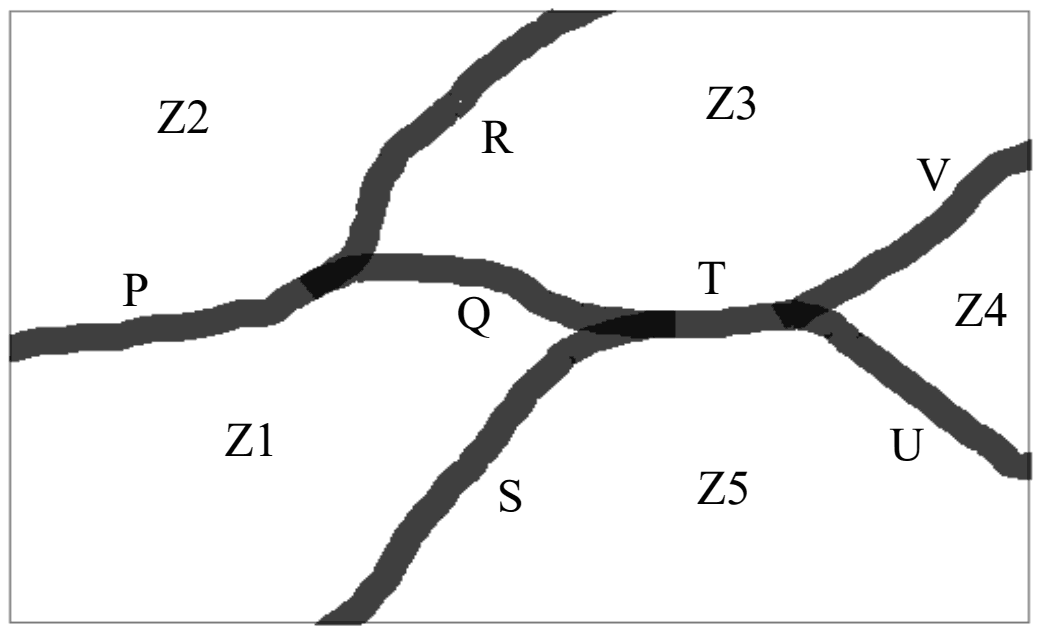
The diagram below shows a river system consisting of 7 segments, marked P, Q, R, S, T, U, and V. It splits the land into 5 zones, marked Z1, Z2, Z3, Z4, and Z5. We need to connect these zones using the least number of bridges. Out of the following options, which one is correct?
Note: The figure shown is representative.
Answer: C
The correct choice is bridges on Q, R, T, and V.
Each river segment separates two zones, so a bridge on it joins those two zones:
- P: Z1-Z2; R: Z2-Z3; Q: Z1-Z3; S: Z1-Z5;
- T: Z3-Z5; V: Z3-Z4; U: Z4-Z5.
Connecting 5 zones needs at least 4 bridges, the edges of a spanning tree. Q, R, T and V join Z1, Z2, Z5 and Z4 each directly to Z3, so all five zones are connected with 4 bridges.
Three bridges (P, Q, T) cannot connect five zones. P, Q, S and T connect Z1, Z2, Z3 and Z5 but leave Z4 cut off, because neither U nor V is bridged. P, Q, S, U and V connects everything but uses 5 bridges, one more than needed.
Post your comment
Please log in or register to post a comment.
Examination Categories
- SSC Exams
- Banking Exams
- Teaching Exams
- Civil Services Exams
- Railways Exams
- Engineering Recruitment Exams
- Defence Exams
- State Government Exams
- Police Exams
- Insurance Exams
- Nursing Exams
- Other Government Exams
- NRA CET
- PG Entrance Exams
- Campus Placement
- MBA Entrance Exams
- CUET and UG Entrance
- Judiciary Exams
- Regulatory Body Exams
- Software Development