
Discussion
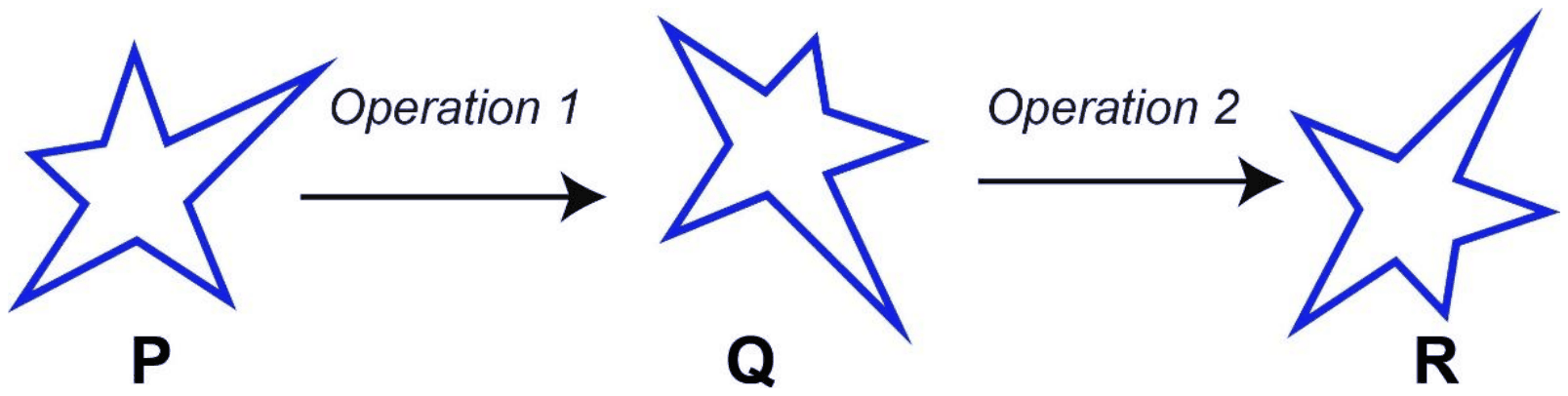
Which one of the options best describes the transformation of the 2-dimensional figure P to Q, and then to R, as shown?
Answer: A
The transformation is a clockwise rotation by 90°, then a reflection along a horizontal line.
Follow the star's one long arm. In P it points to the upper right. In Q it points to the lower right: turning the figure clockwise by 90° carries the upper-right direction to the lower-right, so Operation 1 is a clockwise quarter turn.
In R the long arm points to the upper right again. A reflection in a horizontal line swaps up and down while keeping left and right, which takes the lower-right arm back to the upper right. A reflection in a vertical line would instead send it to the lower left.
A counter-clockwise quarter turn of P would put the long arm at the upper left, not where it is in Q, and a 180° rotation would put it at the lower left. That rules out the other three options.
Post your comment
Please log in or register to post a comment.
Examination Categories
- SSC Exams
- Banking Exams
- Teaching Exams
- Civil Services Exams
- Railways Exams
- Engineering Recruitment Exams
- Defence Exams
- State Government Exams
- Police Exams
- Insurance Exams
- Nursing Exams
- Other Government Exams
- NRA CET
- PG Entrance Exams
- Campus Placement
- MBA Entrance Exams
- CUET and UG Entrance
- Judiciary Exams
- Regulatory Body Exams
- Software Development