
Discussion
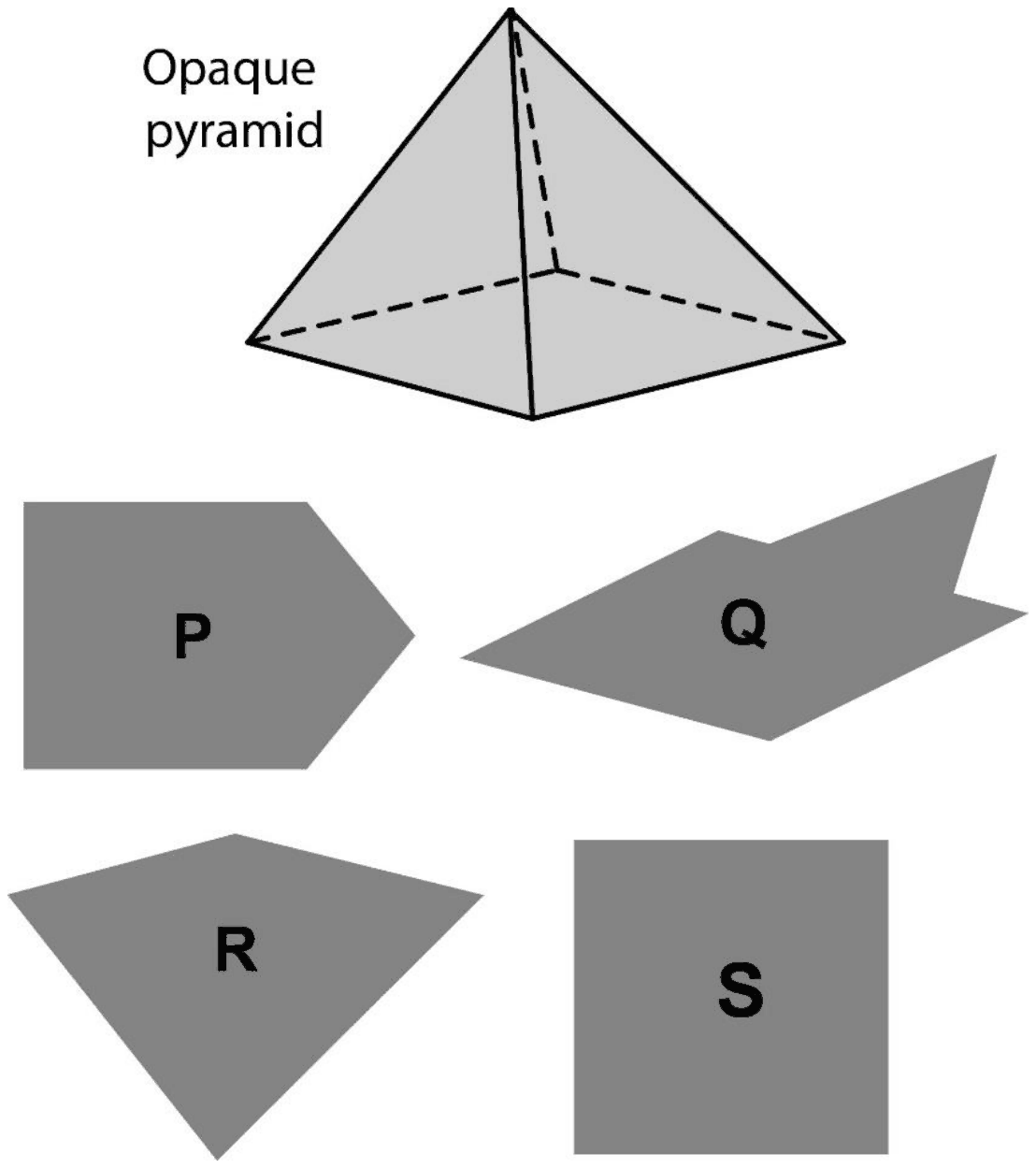
An opaque pyramid (shown below), with a square base and isosceles faces, is suspended in the path of a parallel beam of light, such that its shadow is cast on a screen oriented perpendicular to the direction of the light beam. The pyramid can be reoriented in any direction within the light beam. Under these conditions, which one of the shadows P, Q, R, and S is NOT possible?
Answer: B
The shadow that is NOT possible is Q.
A parallel beam casts a shadow that is the parallel projection of the solid onto the screen. A pyramid is a convex solid, and the projection of a convex solid is always a convex region: any straight segment between two points of the shadow stays inside the shadow. So every possible shadow of the pyramid is a convex polygon.
Shadow Q has a notch cut into its upper edge, a re-entrant corner, so it is not convex and cannot be cast. The others can: looking straight along the axis gives the square S, and tilted orientations give other convex outlines, five-sided like P or four-sided like R, depending on which vertices end up on the boundary of the shadow.
Post your comment
Please log in or register to post a comment.
Examination Categories
- SSC Exams
- Banking Exams
- Teaching Exams
- Civil Services Exams
- Railways Exams
- Engineering Recruitment Exams
- Defence Exams
- State Government Exams
- Police Exams
- Insurance Exams
- Nursing Exams
- Other Government Exams
- NRA CET
- PG Entrance Exams
- Campus Placement
- MBA Entrance Exams
- CUET and UG Entrance
- Judiciary Exams
- Regulatory Body Exams
- Software Development