
Discussion
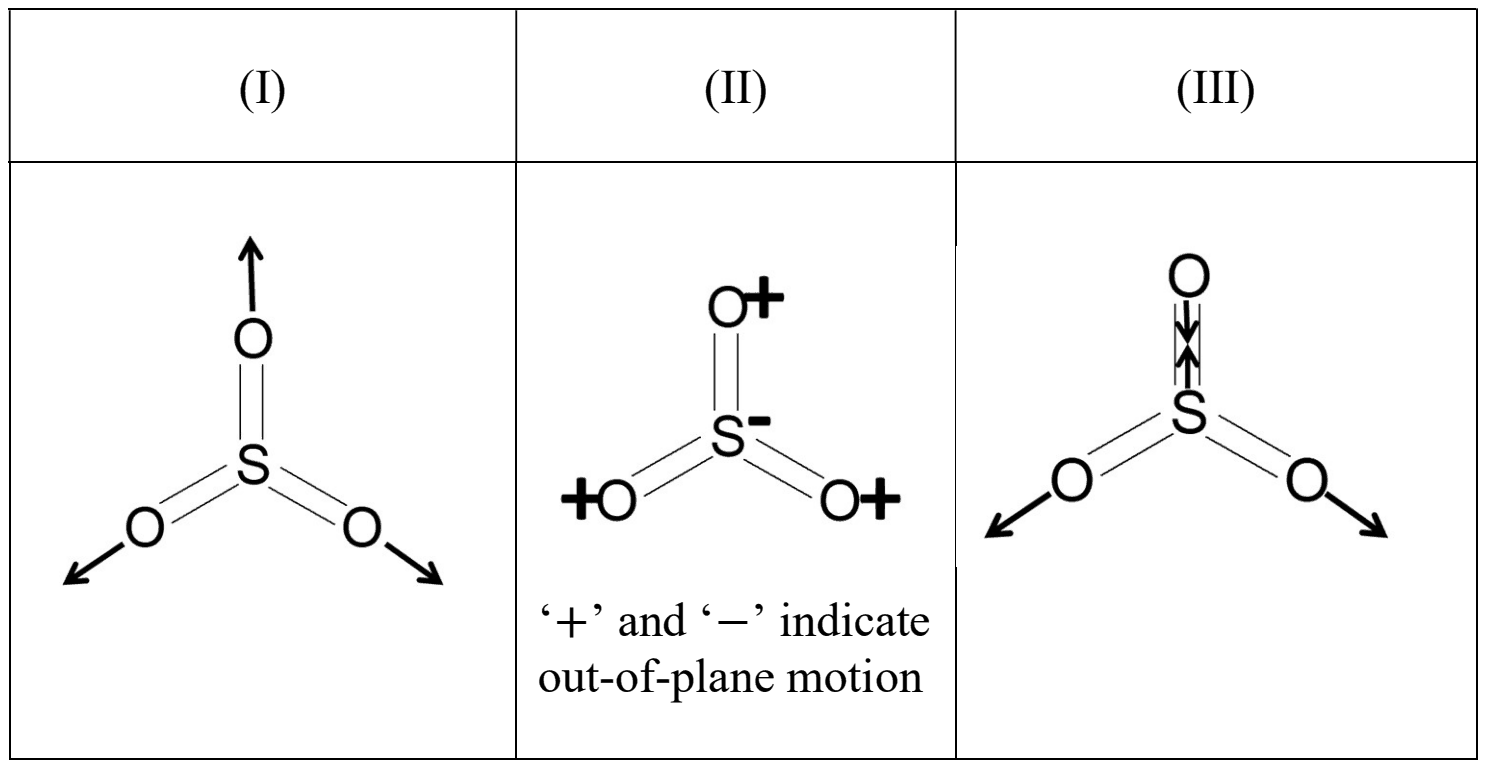
The CORRECT statement regarding the following three normal modes of vibration of SO3 is
Answer: B
The correct statement is (I) is infrared inactive while (II) and (III) are infrared active.
A mode is IR active only if it changes the dipole moment. SO3 is trigonal planar (D3h).
- (I): all three S-O bonds stretch in phase (the symmetric stretch, A1'). The molecule keeps its full symmetry and its dipole stays zero, so this mode is IR inactive (it is Raman active).
- (II): S moves out of the plane one way and the three O atoms the other (A2''). This creates a dipole along the three-fold axis, so it is IR active.
- (III): one S-O bond shortens while the other two lengthen, an asymmetric stretch (E'). The in-plane dipole changes, so it is IR active.
A zero permanent dipole does not make every mode inactive: what matters is whether the vibration makes the dipole oscillate, so the 'none of the modes' option is wrong, and the options calling (III) inactive or (I) active are wrong too.
No comment is present. Be the first to comment.
Loading…
Post your comment
Please log in or register to post a comment.
Examination Categories
- SSC Exams
- Banking Exams
- Teaching Exams
- Civil Services Exams
- Railways Exams
- Engineering Recruitment Exams
- Defence Exams
- State Government Exams
- Police Exams
- Insurance Exams
- Nursing Exams
- Other Government Exams
- NRA CET
- PG Entrance Exams
- Campus Placement
- MBA Entrance Exams
- CUET and UG Entrance
- Judiciary Exams
- Regulatory Body Exams
- Software Development