
Discussion
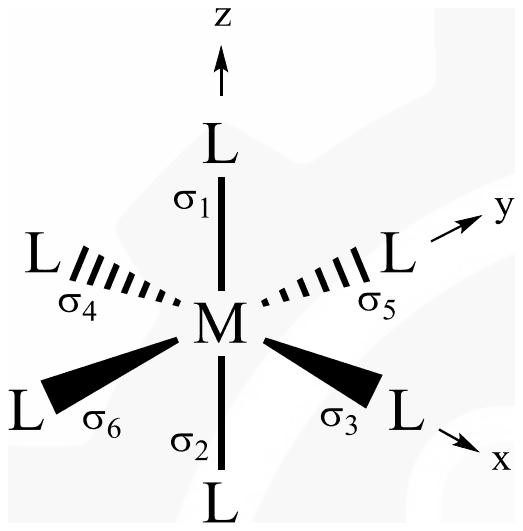
Consider the figure given below, where M is a metal and L is a monodentate ligand. The σ-bonding ligand group orbital (LGO) having same symmetry with \(d_{z^{2}}\) orbital of M in the octahedral coordination geometry is
Answer: A
The ligand group orbital is \(\frac{1}{\sqrt{12}}(2\sigma_1+2\sigma_2-\sigma_3-\sigma_4-\sigma_5-\sigma_6)\).
In \(O_{h}\) the \(d_{z^{2}}\) orbital belongs to eg. Its LGO must copy the orbital's shape: large positive lobes along +z and -z, where \(\sigma_{1}\) and \(\sigma_{2}\) point, and the smaller negative collar in the xy plane, where \(\sigma_{3}\) to \(\sigma_{6}\) point. So \(\sigma_{1}\) and \(\sigma_{2}\) take the same positive weight, twice that of the four equatorial orbitals, which take a negative sign. The normalising factor is
\[ \frac{1}{\sqrt{4 + 4 + 1 + 1 + 1 + 1}} = \frac{1}{\sqrt{12}} \]
The all-positive combination \(\frac{1}{\sqrt{6}}(\sigma_{1} + \dots + \sigma_{6})\) is the a1g LGO that matches the 4s orbital. The \(2\sigma_{1} - 2\sigma_{2}\) option changes sign between +z and -z, which a gerade d orbital never does. The \(\frac{1}{\sqrt{6}}\) option with equal weights of opposite sign is not a symmetry-adapted orbital at all: it is a mixture of the a1g and eg combinations.
Post your comment
Please log in or register to post a comment.
Examination Categories
- SSC Exams
- Banking Exams
- Teaching Exams
- Civil Services Exams
- Railways Exams
- Engineering Recruitment Exams
- Defence Exams
- State Government Exams
- Police Exams
- Insurance Exams
- Nursing Exams
- Other Government Exams
- NRA CET
- PG Entrance Exams
- Campus Placement
- MBA Entrance Exams
- CUET and UG Entrance
- Judiciary Exams
- Regulatory Body Exams
- Software Development