
Discussion
Consider the two cascaded 2-to-1 multiplexers as shown in the figure.
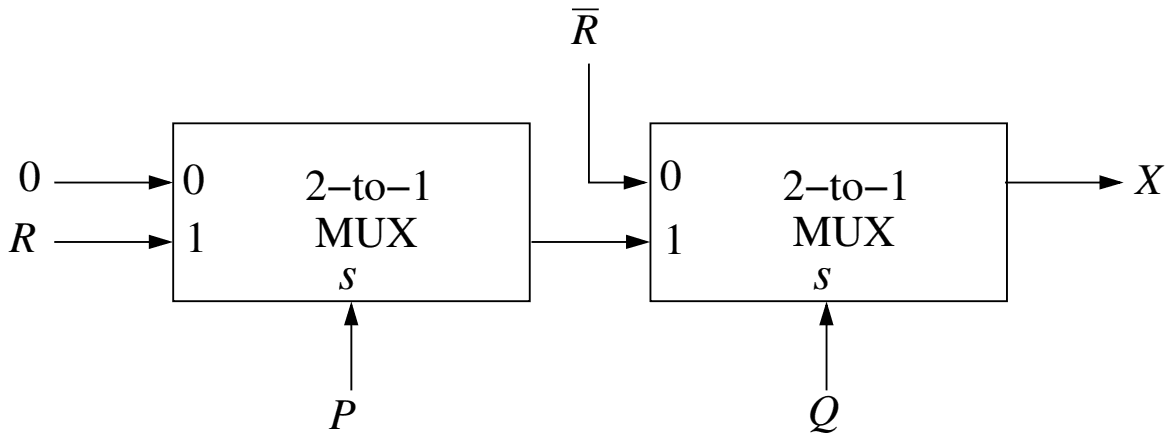
The minimal sum of products form of the output \(X\) is
Answer: D
The output is \(X = \bar{Q}\bar{R} + PQR\).
A 2-to-1 MUX outputs input 0 when its select line is 0 and input 1 when it is 1. The first MUX outputs 0 when \(P = 0\) and \(R\) when \(P = 1\), so its output is \(PR\). The second MUX outputs \(\bar{R}\) when \(Q = 0\) and the first MUX's output \(PR\) when \(Q = 1\):
\[ X = \bar{Q}\bar{R} + Q(PR) = \bar{Q}\bar{R} + PQR \]
The two terms cannot be merged (one needs \(Q = 0\), the other \(Q = 1\)), so this is already minimal. Test values rule out the others: for \(P = 1, Q = 0, R = 0\) the circuit gives \(X = \bar{R} = 1\), but \(\bar{P}\bar{Q} + PQR\) and \(PQ + \bar{P}\bar{Q}R\) both give 0; for \(P = 0, Q = 1, R = 1\) the circuit gives 0, but \(\bar{P}Q + QR\) gives 1.
Post your comment
Please log in or register to post a comment.
Examination Categories
- SSC Exams
- Banking Exams
- Teaching Exams
- Civil Services Exams
- Railways Exams
- Engineering Recruitment Exams
- Defence Exams
- State Government Exams
- Police Exams
- Insurance Exams
- Nursing Exams
- Other Government Exams
- NRA CET
- PG Entrance Exams
- Campus Placement
- MBA Entrance Exams
- CUET and UG Entrance
- Judiciary Exams
- Regulatory Body Exams
- Software Development