
Discussion
A Boolean digital circuit is composed using two 4-input multiplexers (M1 and M2) and one 2-input multiplexer (M3) as shown in the figure. X0-X7 are the inputs of the multiplexers M1 and M2 and could be connected to either 0 or 1. The select lines of the multiplexers are connected to Boolean variables A, B and C as shown.
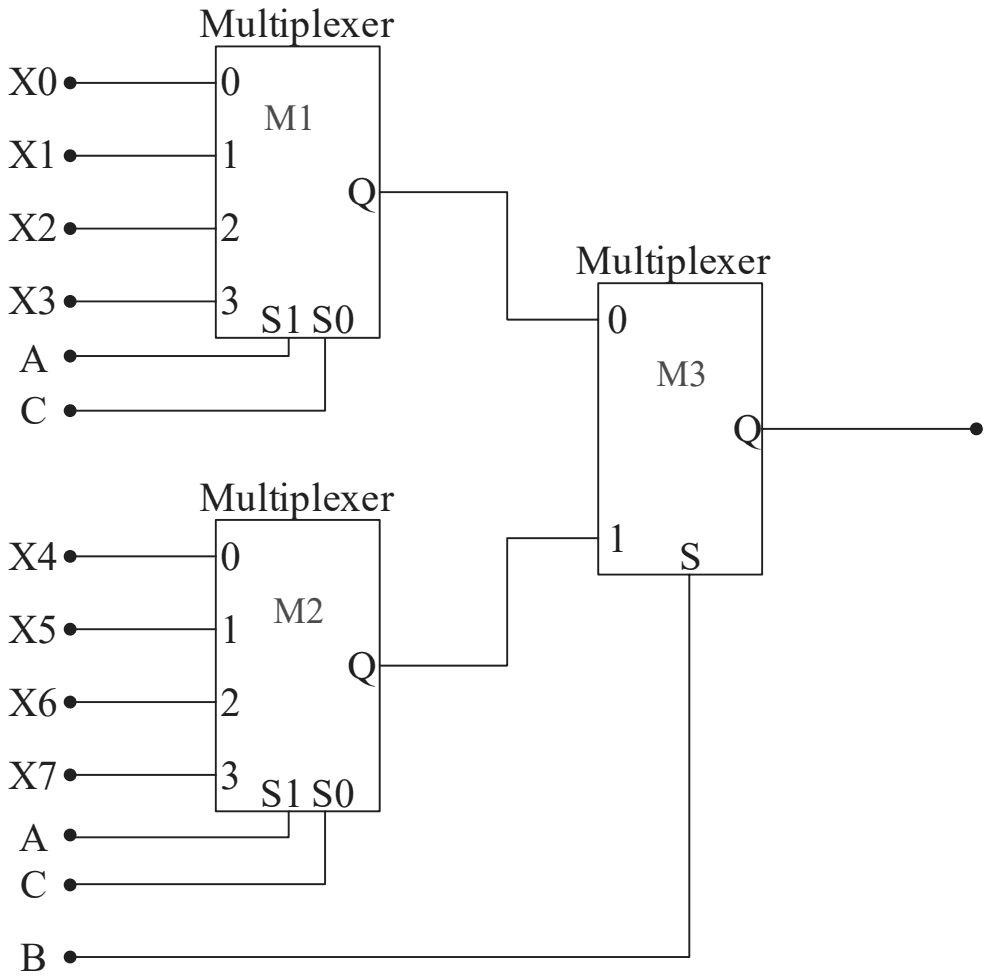
Which one of the following set of values of (X0, X1, X2, X3, X4, X5, X6, X7) will realise the Boolean function \(\overline{A} + \overline{A}.\overline{C} + A.\overline{B}.C\)?
Answer: C
The inputs are (1, 1, 0, 1, 1, 1, 0, 0).
First simplify the function. \(\overline{A}.\overline{C}\) is already covered by \(\overline{A}\), and \(\overline{A} + A.\overline{B}.C = \overline{A} + \overline{B}.C\):
\[ F = \overline{A} + \overline{B}C \]
M3 chooses M1 when B = 0 and M2 when B = 1. Both 4-input multiplexers select their input by (S1, S0) = (A, C).
- B = 0: F = \(\overline{A} + C\). AC = 00, 01, 10, 11 gives X0..X3 = 1, 1, 0, 1.
- B = 1: F = \(\overline{A}\). AC = 00, 01, 10, 11 gives X4..X7 = 1, 1, 0, 0.
The first option puts 0 in X3 and 1 in X6, the second puts 0 in X3 and 1 in X7, and the last sets X0 and X1 to 0, although F = 1 whenever A = 0.
Post your comment
Please log in or register to post a comment.
Examination Categories
- SSC Exams
- Banking Exams
- Teaching Exams
- Civil Services Exams
- Railways Exams
- Engineering Recruitment Exams
- Defence Exams
- State Government Exams
- Police Exams
- Insurance Exams
- Nursing Exams
- Other Government Exams
- NRA CET
- PG Entrance Exams
- Campus Placement
- MBA Entrance Exams
- CUET and UG Entrance
- Judiciary Exams
- Regulatory Body Exams
- Software Development