
Discussion
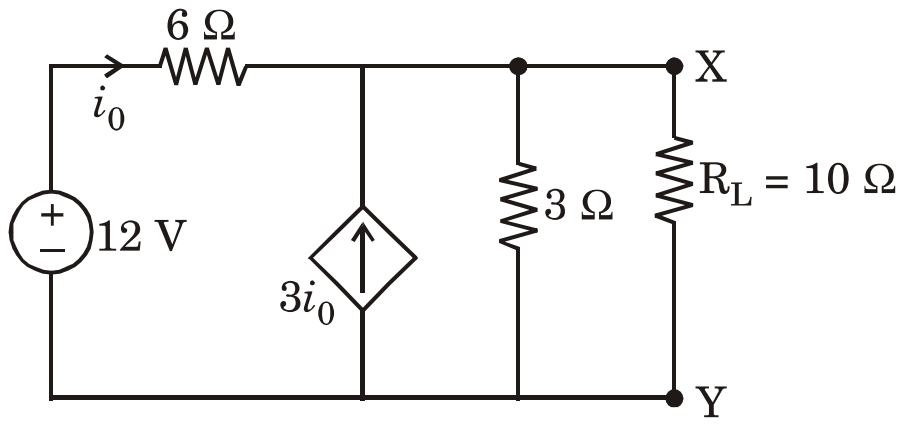
Find the short circuit current (IS.C.) of the following circuit using Norton's theorem :
Answer: C
The short circuit current is 8 A.
Short the terminals X and Y. That puts the 3 Ω resistor and the 10 Ω load in parallel with a short, so neither carries current, and the top node sits at 0 V. The 12 V source then drives the 6 Ω resistor directly:
\[ i_0 = \dfrac{12}{6} = 2\ \text{A} \]
The dependent current source pushes 3i0 upward into the top node:
\[ 3 i_0 = 6\ \text{A} \]
Both currents flow through the short from X to Y, so by KCL at the top node:
\[ I_{S.C.} = i_0 + 3 i_0 = 2 + 6 = 8\ \text{A} \]
The 6 A of option D is only the dependent source's own current, left without the 2 A from the 6 Ω branch. Norton's current is the current through the short, and a dependent source cannot be set to zero when it is found.
Post your comment
Please log in or register to post a comment.
Examination Categories
- SSC Exams
- Banking Exams
- Teaching Exams
- Civil Services Exams
- Railways Exams
- Engineering Recruitment Exams
- Defence Exams
- State Government Exams
- Police Exams
- Insurance Exams
- Nursing Exams
- Other Government Exams
- NRA CET
- PG Entrance Exams
- Campus Placement
- MBA Entrance Exams
- CUET and UG Entrance
- Judiciary Exams
- Regulatory Body Exams
- Software Development