
Discussion
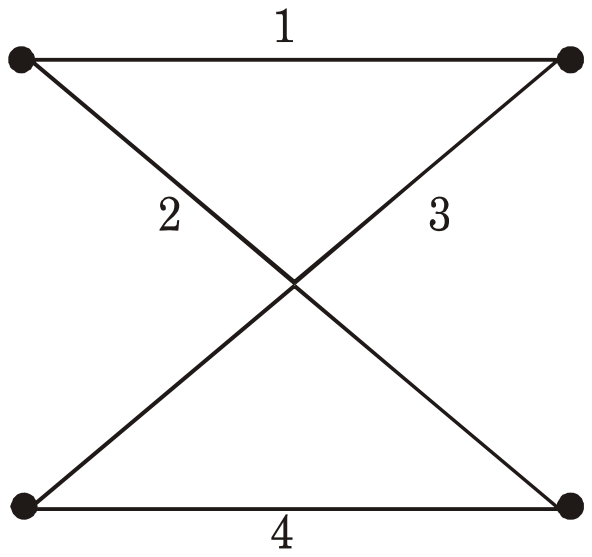
In the graph shown in the following figure, the number of trees (P) and the number of cut sets (Q) are :
Answer: C
The graph has P = 4 trees and Q = 6 cut sets.
The two diagonals cross without a node, so the graph has 4 nodes and 4 branches. Tracing it: top left to top right (1), top right to bottom left (3), bottom left to bottom right (4), and bottom right back to top left (2). It is a single closed loop of four branches.
A tree joins all 4 nodes with 4 - 1 = 3 branches and no loop. Removing any one of the four branches leaves such a tree, so there are 4 trees.
A cut set is a minimal set of branches whose removal splits the graph into two parts. In a single loop, removing one branch leaves it connected, but removing any two branches separates it, so every pair is a cut set: \(\binom{4}{2} = 6\).
Post your comment
Please log in or register to post a comment.
Examination Categories
- SSC Exams
- Banking Exams
- Teaching Exams
- Civil Services Exams
- Railways Exams
- Engineering Recruitment Exams
- Defence Exams
- State Government Exams
- Police Exams
- Insurance Exams
- Nursing Exams
- Other Government Exams
- NRA CET
- PG Entrance Exams
- Campus Placement
- MBA Entrance Exams
- CUET and UG Entrance
- Judiciary Exams
- Regulatory Body Exams
- Software Development