
Discussion
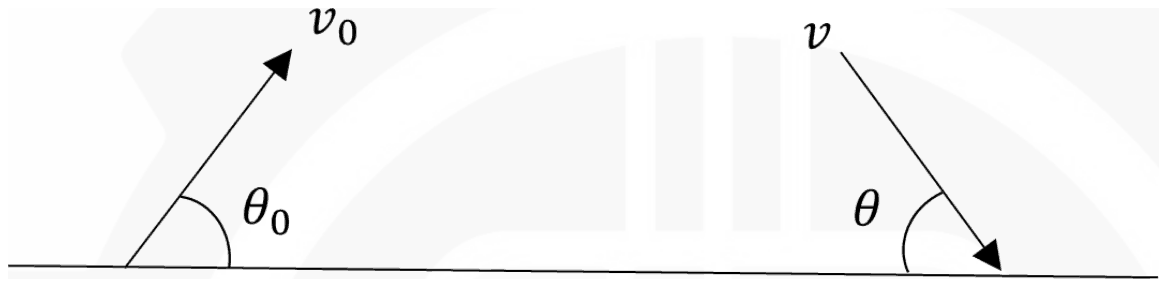
On a horizontal plane, a projectile of mass \(m\) is launched from the ground with speed \(v_{0}\) at an angle \(\theta_{0}\) with the horizontal. In addition to the gravitational force (\(mg\)), it also experiences a drag force \(\vec{F}_{drag} = -\gamma\vec{v}\), where \(\vec{v}\) is its velocity and \(\gamma\) is a constant. It hits the ground at a distance \(R\) from the point of launch with its velocity making an angle \(\theta\) with the horizontal, as shown schematically in the figure. Then which of the following options is correct?
Answer: C
The correct option is \(R \lt v_{0}^{2}\sin 2\theta_{0}/g\) and \(\theta \gt \theta_{0}\).
Without drag the range is \(v_{0}^{2}\sin 2\theta_{0}/g\) and the path is symmetric, landing at the launch angle. A drag force opposite to the velocity takes energy out throughout the flight, so the projectile cannot go as far: \(R\) is less than the drag-free range.
Drag also keeps reducing the horizontal velocity, \(dv_{x}/dt = -(\gamma/m)v_{x}\), so the horizontal speed at impact is less than \(v_{0}\cos\theta_{0}\). The descent is therefore steeper than the ascent, and the impact angle exceeds the launch angle. The options with '=' apply a drag-free formula, and the options with \(\theta \lt \theta_{0}\) get the asymmetry the wrong way round.
Post your comment
Please log in or register to post a comment.
Examination Categories
- SSC Exams
- Banking Exams
- Teaching Exams
- Civil Services Exams
- Railways Exams
- Engineering Recruitment Exams
- Defence Exams
- State Government Exams
- Police Exams
- Insurance Exams
- Nursing Exams
- Other Government Exams
- NRA CET
- PG Entrance Exams
- Campus Placement
- MBA Entrance Exams
- CUET and UG Entrance
- Judiciary Exams
- Regulatory Body Exams
- Software Development