
Discussion
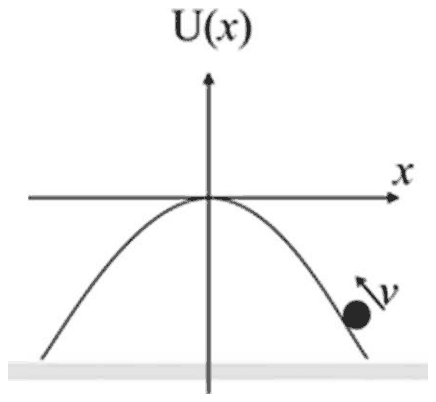
A ball of mass \(m\) climbs the potential \(U(x) = -\frac{1}{2}kx^{2}\), as shown in the figure. Assuming that the total energy of the system \(E = \frac{1}{2}mv^{2} + U(x)\) is conserved, which of the following correctly describe(s) the plot of velocity (\(v\)) as a function of position (\(x\)) of the system for \(E \lt 0\)?
- A.
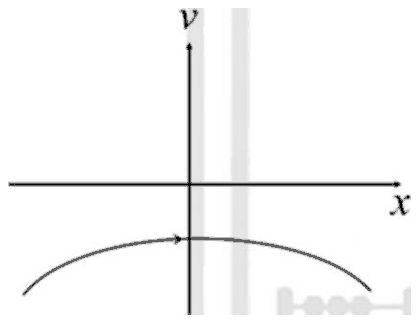
- B.
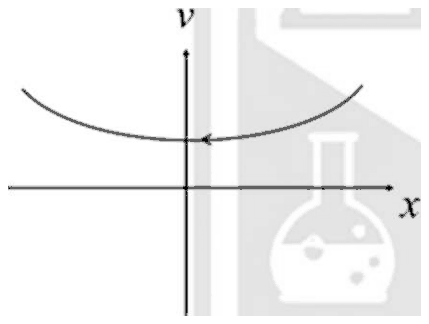
- C.
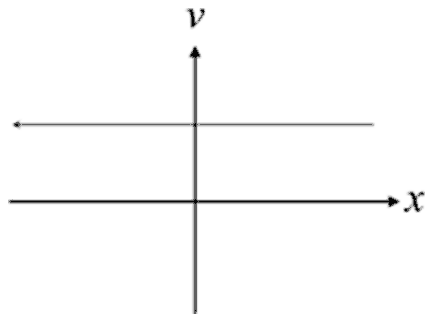
- D.
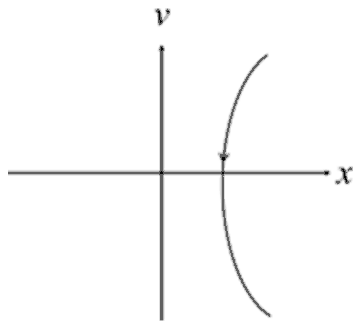
Answer: D
The correct plot is (D), a hyperbola branch that starts at a positive \(x\) and never reaches the \(v\) axis.
Energy conservation gives \(\frac{1}{2}mv^{2} = E - U = E + \frac{1}{2}kx^{2}\), so
\[ v^{2} = \frac{k}{m}\left(x^{2} - x_{0}^{2}\right), \]
where \(x_{0}^{2} = -\frac{2E}{k}\).
With \(E \lt 0\), \(x_{0}^{2} \gt 0\). Real velocities exist only for \(|x| \geq x_{0}\), where the particle is on the hill below its energy level; for \(|x| \lt x_{0}\) the potential energy \(U\) is higher than \(E\), which is forbidden. The curve \(v\) against \(x\) is a hyperbola whose branch on the right (the side the ball climbs on) crosses the \(x\) axis at \(x_{0}\), at the turning point where the ball stops.
(A) and (B) are closed arcs of the kind \(v^{2} = c - \frac{k}{m}x^{2}\), the trace of an oscillation in a well. (C) is a constant speed, which happens only with no force. Only (D) matches \(v^{2} \propto x^{2} - x_{0}^{2}\). The official key lists only D.
Post your comment
Please log in or register to post a comment.
Examination Categories
- SSC Exams
- Banking Exams
- Teaching Exams
- Civil Services Exams
- Railways Exams
- Engineering Recruitment Exams
- Defence Exams
- State Government Exams
- Police Exams
- Insurance Exams
- Nursing Exams
- Other Government Exams
- NRA CET
- PG Entrance Exams
- Campus Placement
- MBA Entrance Exams
- CUET and UG Entrance
- Judiciary Exams
- Regulatory Body Exams
- Software Development