
Discussion
As shown in the figure a ball of mass m suspended by an inextensible massless string is released from height h and collides elastically when it is at its lowest point with a block of mass 2m at rest on a frictionless surface. After the collision the ball will rise to a total height equal to :
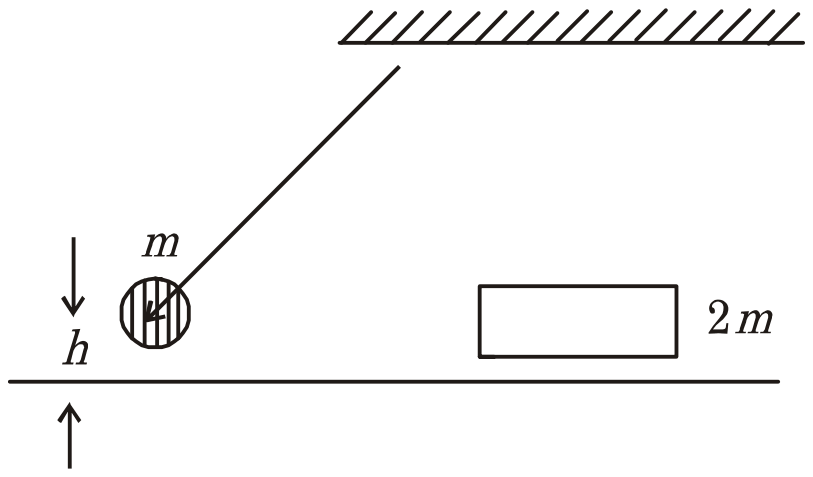
Answer: A
The ball rises to h/9.
Just before impact the ball's speed is \(u = \sqrt{2gh}\). In a one-dimensional elastic collision of mass \(m_{1} = m\) with a stationary \(m_{2} = 2m\), the first body's velocity after impact is
\[ \begin{aligned} v_{1} &= \frac{m_{1} - m_{2}}{m_{1} + m_{2}}\,u \\ &= \frac{m - 2m}{3m}\,u = -\frac{u}{3} \end{aligned} \]
The ball rebounds with a third of its speed. The height reached scales as the square of the speed:
\[ \begin{aligned} h' &= \frac{v_{1}^{2}}{2g} \\ &= \frac{1}{9}\cdot\frac{u^{2}}{2g} = \frac{h}{9} \end{aligned} \]
The option h/3 forgets to square the speed ratio, and 2h/3 and h/8 do not follow from the elastic collision formulas.
Post your comment
Please log in or register to post a comment.
Examination Categories
- SSC Exams
- Banking Exams
- Teaching Exams
- Civil Services Exams
- Railways Exams
- Engineering Recruitment Exams
- Defence Exams
- State Government Exams
- Police Exams
- Insurance Exams
- Nursing Exams
- Other Government Exams
- NRA CET
- PG Entrance Exams
- Campus Placement
- MBA Entrance Exams
- CUET and UG Entrance
- Judiciary Exams
- Regulatory Body Exams
- Software Development