
Discussion
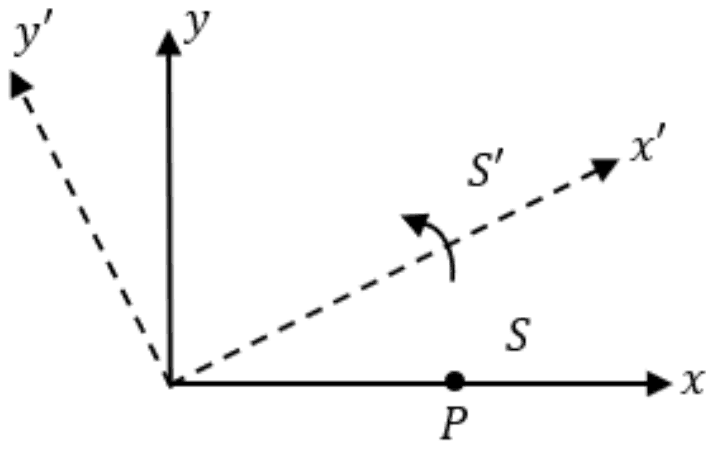
Two frames \(S\) (solid lines) and \(S'\) (dashed lines) with common origin are shown in the figure below. Frame \(S\) is inertial while \(S'\) is rotating about the common \(z\)-axis. There is a point mass fixed at \(P\) on the \(x\)-axis of the \(S\) frame. The magnitude of the centrifugal force and the Coriolis force experienced by the mass in the \(S'\) frame is \(F_{cen}\) and \(F_{cor}\), respectively. Which of the following options is correct for these forces?
Answer: B
Both forces are non-zero, with \(F_{cen} = F_{cor}/2\).
In the rotating frame S' the mass, fixed in S at distance r from the axis, appears to move in a circle at speed \(v' = \omega r\), opposite to the frame's rotation. The fictitious forces are:
\[ \begin{aligned} F_{cen} &= m\omega^{2}r\ \text{(outward)} \\ F_{cor} &= 2m\omega v' = 2m\omega^{2}r\ \text{(inward)} \end{aligned} \]
Their sum is \(m\omega^{2}r\) inward, exactly the centripetal force needed for the circular motion seen in S', with no real force acting. The forces are not zero, because S' is rotating, and the Coriolis force is twice, not half or equal to, the centrifugal force, which rules out the remaining options.
Post your comment
Please log in or register to post a comment.
Examination Categories
- SSC Exams
- Banking Exams
- Teaching Exams
- Civil Services Exams
- Railways Exams
- Engineering Recruitment Exams
- Defence Exams
- State Government Exams
- Police Exams
- Insurance Exams
- Nursing Exams
- Other Government Exams
- NRA CET
- PG Entrance Exams
- Campus Placement
- MBA Entrance Exams
- CUET and UG Entrance
- Judiciary Exams
- Regulatory Body Exams
- Software Development