
Discussion
Two vehicles A and B are approaching an observer O at rest with equal speed as shown in the figure. Both vehicles have identical sirens blowing at a frequency \(f_{s}\). The observer hears these sirens at frequency \(f_{A}\) and \(f_{B}\), respectively from the two vehicles. Which one of the following is correct?
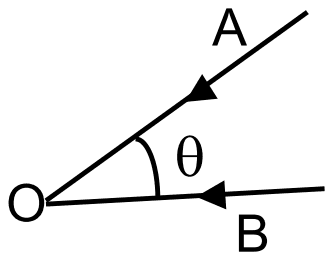
Answer: B
The answer is \(f_{A} = f_{B} \gt f_{s}\).
The Doppler shift depends on the component of the source's velocity along the line joining source and observer. Both vehicles move straight towards O, so for each the whole speed lies along that line:
\[ \begin{aligned} f &= f_{s}\,\frac{v_{\text{sound}}}{v_{\text{sound}} - v_{\text{source}}} \\ &\gt f_{s} \end{aligned} \]
The speeds are equal, so the two heard frequencies are equal. The angle \(\theta\) between the two paths does not matter, because neither vehicle is moving at an angle to its own line of sight. Since both approach, both frequencies are raised, ruling out the options with \(f \lt f_{s}\).
Post your comment
Please log in or register to post a comment.
Examination Categories
- SSC Exams
- Banking Exams
- Teaching Exams
- Civil Services Exams
- Railways Exams
- Engineering Recruitment Exams
- Defence Exams
- State Government Exams
- Police Exams
- Insurance Exams
- Nursing Exams
- Other Government Exams
- NRA CET
- PG Entrance Exams
- Campus Placement
- MBA Entrance Exams
- CUET and UG Entrance
- Judiciary Exams
- Regulatory Body Exams
- Software Development