
Discussion
A paper shown in Panel I is folded along the dashed lines (- - -) to construct a cube. The shaded regions shown in Panel I appear on the outer surface of the cube. Referring to cubes shown in Panel II, which one of the options is correct?
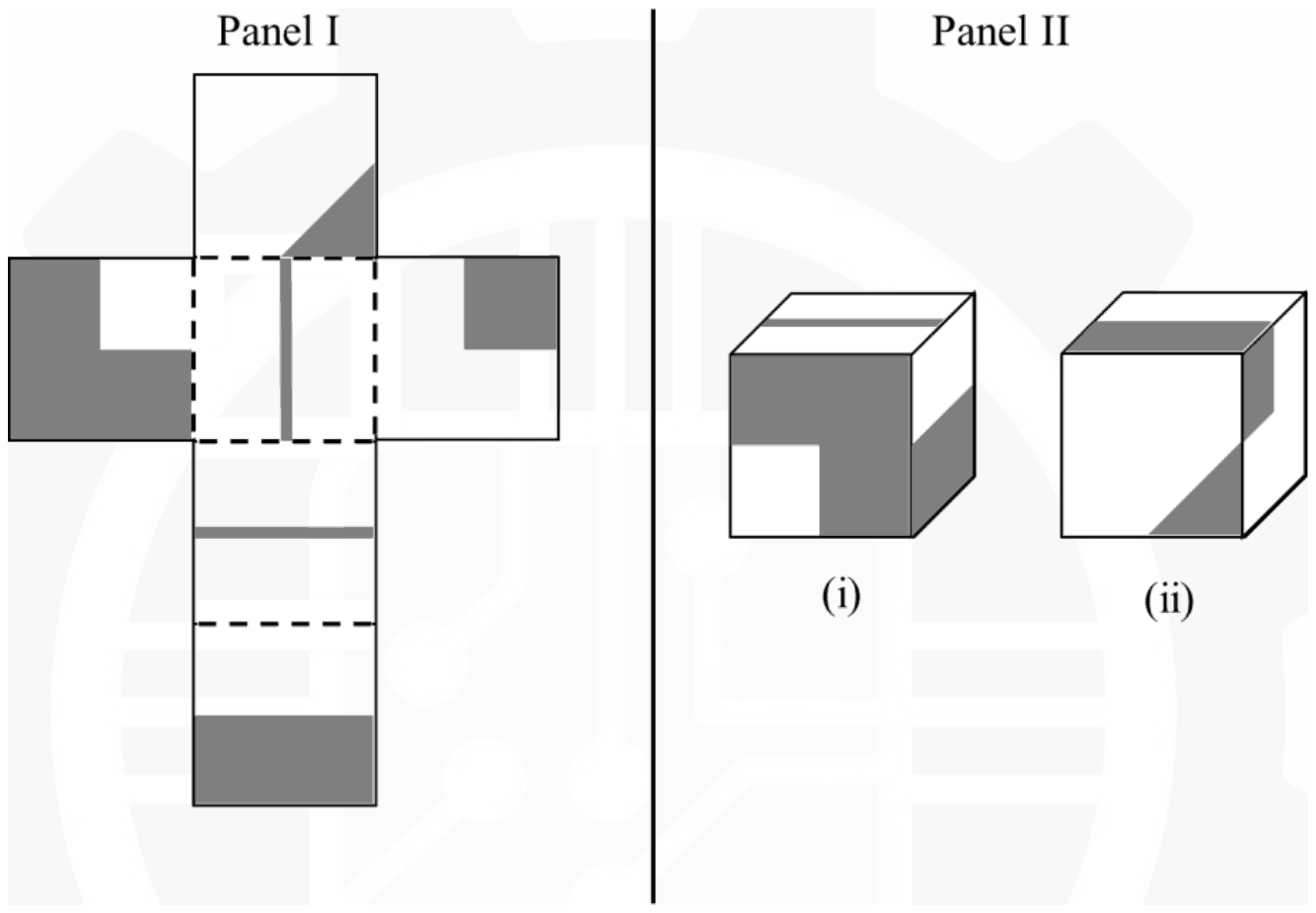
Answer: B
Only (ii) can be made from the sheet.
Because the printed side ends up outside, the centre square (with the thin vertical line) becomes one face, call it the top, and the squares above, left, right and below it fold down as the four sides. The bottom square of the column folds under as the face opposite the centre. The square with the corner triangle has its triangle in the corner it shares with the centre square and the right-hand square; the right-hand square's shaded quarter sits in its corner farthest from the centre and next to the triangle square; the last square is shaded on the half next to the triangle square once folded.
Cube (ii): put the triangle face in front with the triangle at its lower right. The right-hand square then lies on the right and the last square on top. The shaded quarter of the right face lands at its upper front corner, and the shaded half of the top face lies along the front edge, exactly as drawn.
Cube (i): its front is the left-hand square, the only face shaded all over except one quarter. With that white quarter at the lower left, the face drawn on top is the square with the thin line, and the line must run from front to back, parallel to the edge shared with the centre face. Cube (i) shows it parallel to the front edge, so (i) cannot come from the sheet. That rules out the options naming (i) and the 'neither' option.
Post your comment
Please log in or register to post a comment.
Examination Categories
- SSC Exams
- Banking Exams
- Teaching Exams
- Civil Services Exams
- Railways Exams
- Engineering Recruitment Exams
- Defence Exams
- State Government Exams
- Police Exams
- Insurance Exams
- Nursing Exams
- Other Government Exams
- NRA CET
- PG Entrance Exams
- Campus Placement
- MBA Entrance Exams
- CUET and UG Entrance
- Judiciary Exams
- Regulatory Body Exams
- Software Development