
Discussion
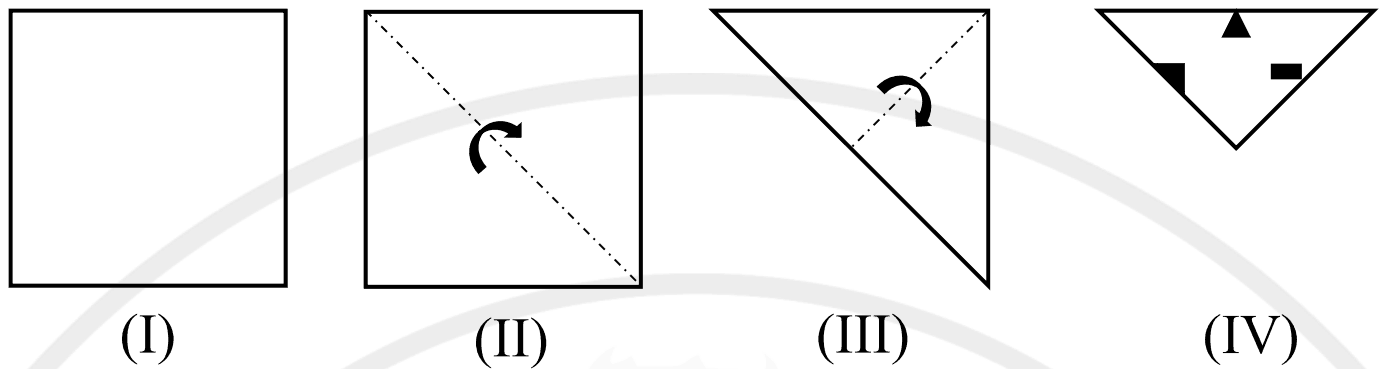
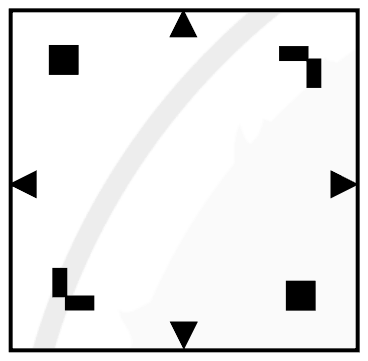
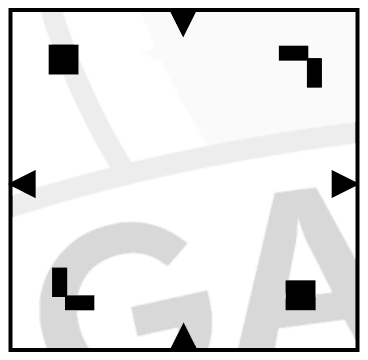
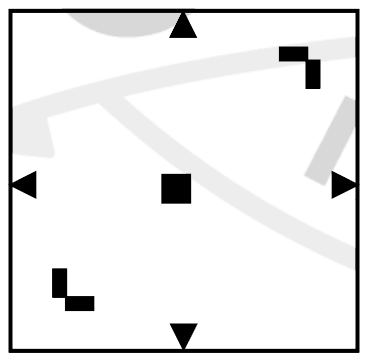
A square paper, shown in figure (I), is folded along the dotted lines as shown in the figures (II) and (III). Then a few cuts are made as shown in figure (IV). Which one of the following patterns will be obtained when the paper is unfolded?
Note: The figures shown are representative.
- A.
- B.

- C.
- D.
Answer: A
The unfolded pattern is (A).
The paper is folded first along the diagonal from top-left to bottom-right, then along the other diagonal's half, leaving a quarter of the square whose top edge is one side of the original square and whose apex is the centre. Unfolding reflects each cut across both diagonals, so the final pattern must be symmetric about both diagonals.
The triangular notch on the top edge points outward, so every side gets an outward-pointing notch at its midpoint; (C) has the top and bottom notches pointing inward. The square cut sits on the first diagonal fold near the top-left corner, so it unfolds to an upright square at the top-left and, by the second fold, at the bottom-right. Reflection across a diagonal keeps an upright square upright, which rules out the diamonds in (B), and (D) has a single square at the centre instead. The bar near the second fold opens into the hooked shapes at the other two corners, as (A) shows.
Post your comment
Please log in or register to post a comment.
Examination Categories
- SSC Exams
- Banking Exams
- Teaching Exams
- Civil Services Exams
- Railways Exams
- Engineering Recruitment Exams
- Defence Exams
- State Government Exams
- Police Exams
- Insurance Exams
- Nursing Exams
- Other Government Exams
- NRA CET
- PG Entrance Exams
- Campus Placement
- MBA Entrance Exams
- CUET and UG Entrance
- Judiciary Exams
- Regulatory Body Exams
- Software Development