
Discussion
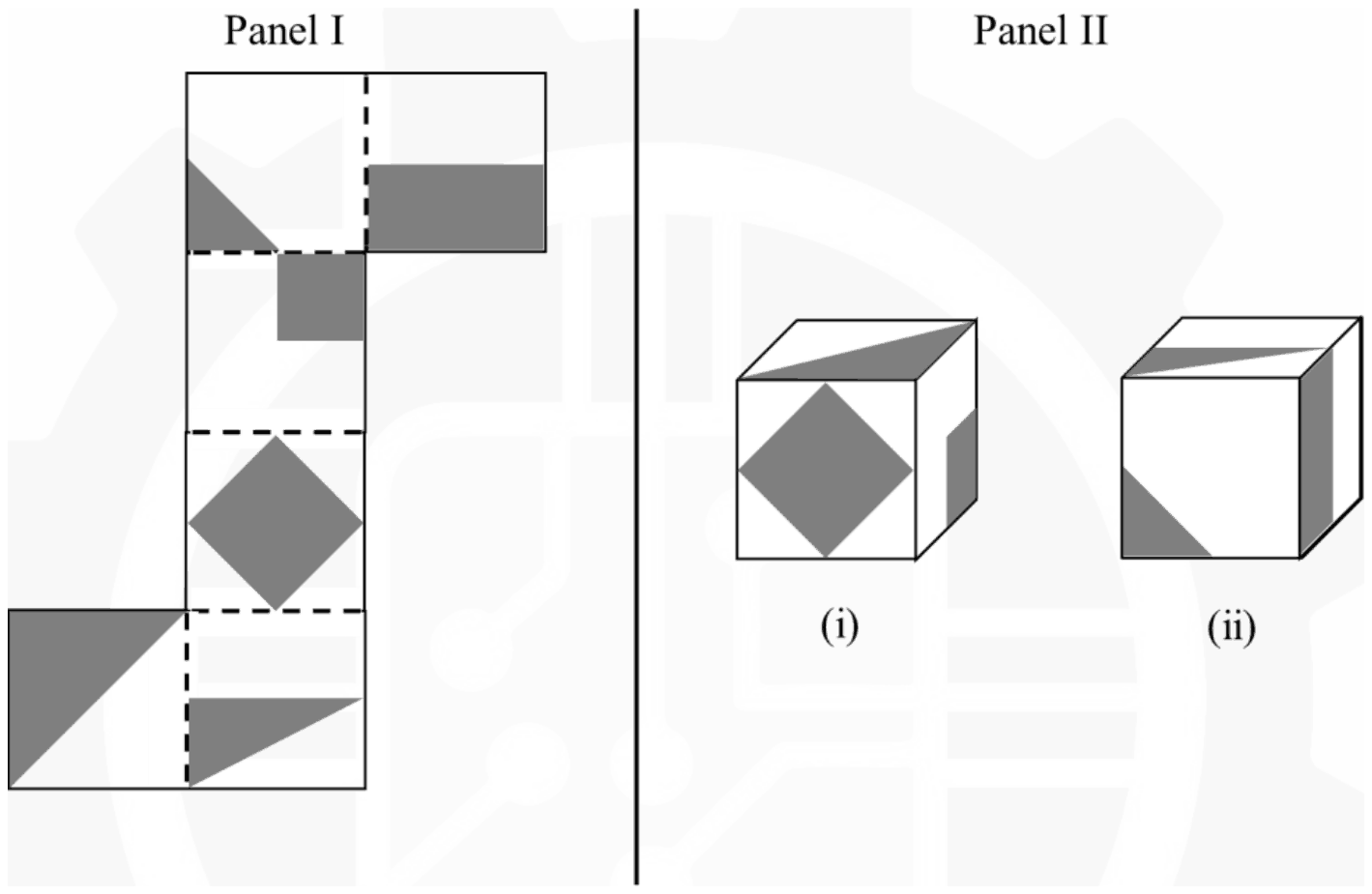
A paper shown in Panel I is folded along the dashed lines (- - -) to construct a cube. The shaded regions shown in Panel I appear on the outer surface of the cube. Referring to cubes shown in Panel II, which one of the options is correct?
Answer: A
Only (i) can come from the net in Panel I.
In the net, a column of four squares folds into a ring: the corner-triangle square, the small-square face, the diamond face and the thin-wedge face. The flap with the half-shaded rectangle is joined to the right of the corner-triangle square, and the flap with the large diagonal triangle is joined to the left of the thin-wedge square. Turn the folded cube so that the diamond is in front and the large-diagonal flap is on top: that flap then shows its shaded half along the diagonal of the top face, and the small-square face comes to the right side with its square at the lower back corner. That is cube (i).
In cube (ii) the front is the corner-triangle face, which can sit with its triangle at the lower left in only one way. In that position the thin-wedge face is on top, as drawn, but the right face must be the half-shaded flap with its shaded half as a horizontal band along the bottom. Cube (ii) shows a vertical strip instead, so it cannot be folded from this net. That rules out the options that accept (ii).
Post your comment
Please log in or register to post a comment.
Examination Categories
- SSC Exams
- Banking Exams
- Teaching Exams
- Civil Services Exams
- Railways Exams
- Engineering Recruitment Exams
- Defence Exams
- State Government Exams
- Police Exams
- Insurance Exams
- Nursing Exams
- Other Government Exams
- NRA CET
- PG Entrance Exams
- Campus Placement
- MBA Entrance Exams
- CUET and UG Entrance
- Judiciary Exams
- Regulatory Body Exams
- Software Development