
Discussion
For the solution of \(\nabla^{2} u = 0\), the domain and boundary conditions are shown below.
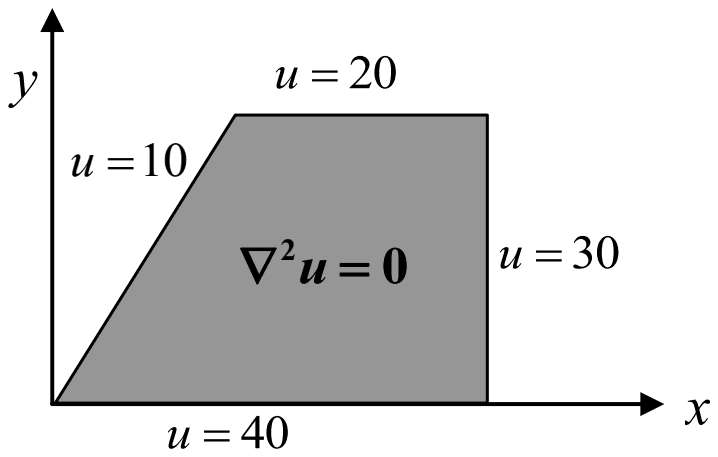
Which of the following statements is TRUE?
Answer: C
The true statement is that the solution cannot be obtained using separation of variables because not all the boundaries are along constant coordinate lines.
Separation of variables in Cartesian coordinates needs a domain whose sides are lines of constant x or constant y, so that each boundary condition can be imposed on one factor of the product solution. Here the left side is a slanted line through the origin, which is neither, so the method fails for this domain.
Laplace's equation itself is separable, so the first option is wrong. Non-zero boundary values are handled by superposing several separated solutions, so the second is wrong. And the slanted edge means the fourth option is wrong as posed.
Post your comment
Please log in or register to post a comment.
Examination Categories
- SSC Exams
- Banking Exams
- Teaching Exams
- Civil Services Exams
- Railways Exams
- Engineering Recruitment Exams
- Defence Exams
- State Government Exams
- Police Exams
- Insurance Exams
- Nursing Exams
- Other Government Exams
- NRA CET
- PG Entrance Exams
- Campus Placement
- MBA Entrance Exams
- CUET and UG Entrance
- Judiciary Exams
- Regulatory Body Exams
- Software Development