
Discussion
A gas of \(N\) classical particles that can occupy energy levels, \(\epsilon_{1}\) and \(\epsilon_{2} = \epsilon_{1} + \Delta\) is in equilibrium with a reservoir at temperature \(T\). From the schematics shown below, choose the correct dependence of the internal energy \(U\) on \(T\).
- A.
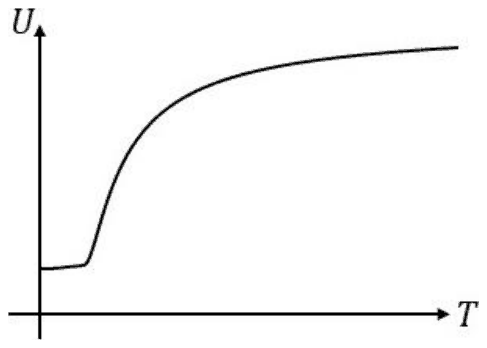
- B.
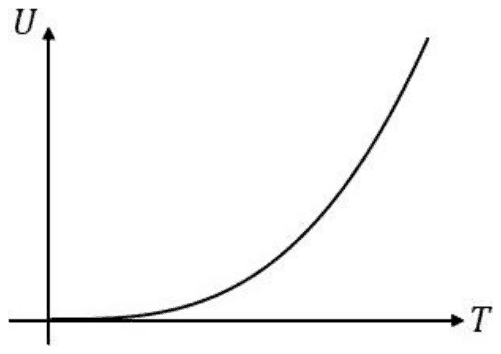
- C.
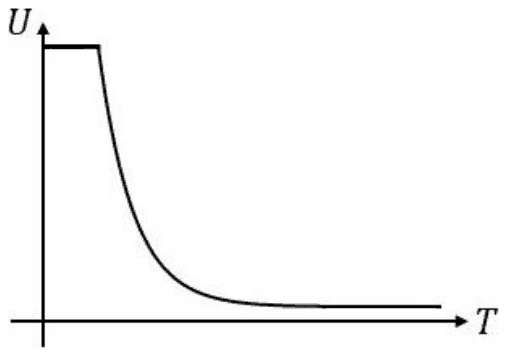
- D.
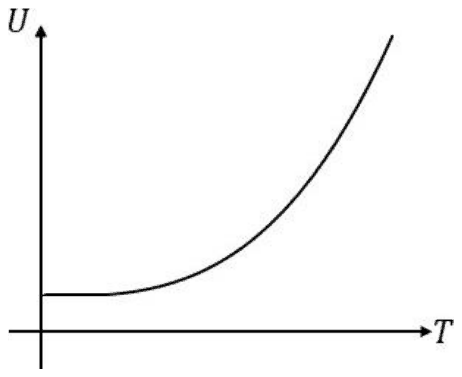
Answer: A
The correct dependence is (A): U starts flat at a non-zero value, rises, and levels off.
For a classical two-level system the occupation follows the Boltzmann factor, so
\[ \begin{aligned} U &= N\epsilon_{1} + N\Delta\,p_{2} \\ p_{2} &= \frac{e^{-\Delta/k_{B}T}}{1 + e^{-\Delta/k_{B}T}} \end{aligned} \]
At low T almost every particle is in the lower level, so \(U \approx N\epsilon_{1}\), and the rise is exponentially slow until \(k_{B}T\) approaches \(\Delta\). At high T the two levels become equally occupied, so U saturates at \(N(\epsilon_{1} + \Delta/2)\) instead of growing without limit.
(B) and (D) keep rising ever more steeply, as for a system with unlimited levels. (C) has U falling as T rises, which would mean a negative heat capacity.
Post your comment
Please log in or register to post a comment.
Examination Categories
- SSC Exams
- Banking Exams
- Teaching Exams
- Civil Services Exams
- Railways Exams
- Engineering Recruitment Exams
- Defence Exams
- State Government Exams
- Police Exams
- Insurance Exams
- Nursing Exams
- Other Government Exams
- NRA CET
- PG Entrance Exams
- Campus Placement
- MBA Entrance Exams
- CUET and UG Entrance
- Judiciary Exams
- Regulatory Body Exams
- Software Development